


Views: 0 Author: Site Editor Publish Time: 2026-11-03 Origin: Site


The defining advantage of extruded polystyrene (XPS) over expanded polystyrene (EPS) is its ability to block water. When XPS is buried under a foundation or installed on an inverted roof, it insulates because its internal structure remains dry. The physical mechanism behind this is the closed-cell rate, and controlling it happens entirely at the extrusion die.
This guide details how a CO2 XPS production line creates a closed-cell structure, why cells collapse, and how European standard EN 13164 measures the resulting water absorption.
Closed cells block water. A closed-cell rate of 95% to 99% means each gas bubble is sealed by a continuous polymer wall. Open cells act like a sponge, drawing water into the board.
Water kills thermal resistance. Water is a thermal conductor. When XPS absorbs moisture in the field, its long-term thermal resistance (R-value) drops drastically below the factory declaration.
Melt temperature is the primary lever. If the melt is too hot at the die, the polymer lacks the melt strength to contain the expanding gas, causing the cell walls to rupture.
EN 13164 demands two tests. Acceptance testing for the European market measures both long-term water absorption by total immersion (WL(T)) and by diffusion (WD(V)).
Cell collapse has a visual signature. A poor closed-cell rate often correlates with a rough, dusty board surface and poor compressive strength, signaling a process failure upstream.
The closed-cell rate is a volumetric percentage. It measures how many of the microscopic bubbles inside the foam are completely encapsulated by continuous polystyrene walls, isolated from the bubbles next to them. Premium XPS targets a closed-cell rate of over 95%, often reaching 99%.
This metric is a direct proxy for moisture resistance. If a cell is closed, water cannot enter it without breaking the polymer wall. If a cell is open (ruptured), it forms a capillary pathway to the next cell. When XPS is exposed to wet soil or standing water, open cells pull moisture deep into the core.
But the closed-cell rate does not measure the size of the cells. A board can have large cells or fine cells and still maintain a 99% closed rate. The size of the cells influences the board's thermal conductivity and compressive strength, but the integrity of the cell walls determines whether the board will survive a wet environment.
The closed-cell structure is created in the few milliseconds after the polymer exits the extrusion die. Inside the barrel, the blowing agent (such as CO2) is dissolved in the liquid polystyrene under extreme pressure. As the melt passes through the die lips into atmospheric pressure, the dissolved gas expands violently, blowing the cells.
To keep those cells closed, the polymer must have enough "melt strength" to stretch around the expanding gas bubble without tearing. This requires precise control of three variables:
Melt Temperature at the Die. This is the most critical lever. If the melt is too hot, the polystyrene is too fluid; it cannot contain the expanding gas, and the cell walls rupture (open cells). If the melt is too cold, it freezes before the board can expand to its target thickness. The tandem extruder design exists primarily to cool the melt down to the exact temperature required for maximum melt strength.
Pressure Drop. The pressure inside the die must be maintained right up to the die lips. If the pressure drops prematurely inside the tooling, the gas will pre-foam, creating chaotic, broken cells before the board reaches the calibrator.
Blowing Agent Dispersion. If the CO2 is not mixed perfectly homogeneously into the polymer by the primary extruder, pockets of pure gas will form large, weak cells that easily collapse during expansion.
When an operator sees water absorption failing in the lab, the corrective action almost always involves dropping the melt temperature in the secondary cooling extruder or adjusting the dynamic mixer to improve gas dispersion.
Because XPS is used in demanding environments like below-grade foundations, civil engineering and green roofs, standard laboratory testing simulates long-term exposure. Water absorption is measured in two fundamentally different ways.
Water Absorption by Immersion. This test submerges the board entirely in water for an extended period (typically 28 days). It measures how much liquid water physically enters the board through capillary action. A high immersion absorption result directly indicates a low closed-cell rate or severe micro-cracking in the foam structure.
Water Absorption by Diffusion. This test exposes one side of the board to high humidity and a temperature gradient, forcing water vapor through the material, which then condenses inside the colder sections of the foam. Diffusion testing evaluates the long-term integrity of the cell walls under vapor pressure, which is critical for inverted roofs where the board sits under wet ballast but above the waterproofing membrane.
A board might pass a short-term immersion test because its smooth, dense outer skin protects it, but fail a 28-day diffusion test because its internal cell walls are too thin or heavily ruptured.
EN 13164 is the European standard for factory-made extruded polystyrene foam products. It does not dictate how the machine is built; it dictates the thresholds the final product must meet. When a buyer demands EN 13164 compliance, they are demanding specific testing classes for water absorption.
For example, the standard uses designations like WL(T)0,7 (as detailed in DIN EN 13164 standards documentation) (Water absorption by long-term total immersion ≤ 0.7% by volume) and WD(V)3 (Water absorption by diffusion ≤ 3% by volume).
Meeting strict classes like WL(T)0,7 places intense demands on the extrusion line's stability. It means the secondary extruder must maintain a stable melt temperature within ±1 °C. It requires a high-quality die that does not introduce shear heating, and downstream calibrators that cool the board gently enough to prevent thermal shock, which can cause micro-cracking across the cell walls.
Note: MXZ provides the manufacturing equipment capable of producing premium XPS. We do not issue EN 13164 certifications; manufacturers must have their boards tested and certified by accredited third-party laboratories using their specific resin and blowing agent formulations.
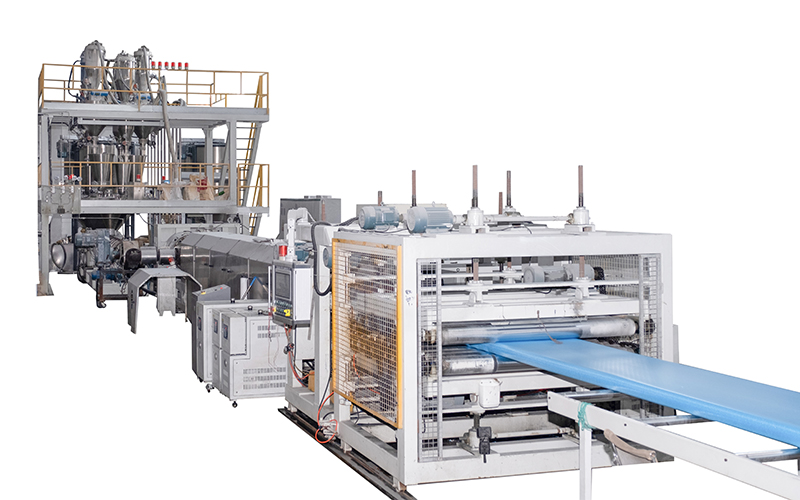
A poor closed-cell rate does not just fail a lab test weeks later; it leaves a physical signature on the production line that an experienced operator can spot immediately.
If the melt temperature is too high or the blowing agent is overdosed, the cell walls stretch too thin and rupture. The expanding gas escapes rather than staying trapped inside the board. This is cell collapse. The visual and physical symptoms include:
Surface Dusting: The board surface feels rough or powdery, indicating that the outermost layer of cells has ruptured completely.
Poor Compressive Strength: If the cells are open, they cannot support weight. The board will crush easily under pressure, failing its kPa specification.
Density Spikes: Because the gas escaped, the foam did not expand fully. The board will be heavier than the target density.
Corrugation: Severe cell collapse often causes the board to shrink unevenly as it cools, creating wavy corrugations along the surface.
If these symptoms appear, the board will fail any water absorption test. The immediate fix is to check the melt temperature thermocouple in the die and reduce the screw speed of the primary extruder to lower the shear heat generation.
Controlling water absorption requires a disciplined sampling protocol. Because cell structure can vary slightly across the width of the board, lab samples must be representative.
Do not take samples from the extreme edges of the board, as the edge cooling dynamics are different from the core. Samples should be cut from the center and the quarter-points of the web. because CO2 diffuses out of the board and air diffuses in during the first few weeks after production, testing should be conducted after the boards have aged for the standard period specified by EN 13164 (often 28 days for declared values).
For high-end civil engineering applications, buyers will demand continuous lot testing. The production line must be stable enough to produce the exact same closed-cell rate at 2:00 AM as it does at 2:00 PM, which underscores the necessity of automated temperature controls and stable cooling water infrastructure.
The closed-cell rate is the invisible metric that defines the commercial value of XPS insulation. Without a continuous, sealed cellular structure, the board will absorb water, lose its thermal resistance, and fail in the field.
Controlling this rate requires mastering the melt strength at the die lips. Operators must balance melt temperature, pressure drop, and blowing agent dispersion to ensure the polymer stretches without tearing. Equipment capable of holding these variables within tight tolerances is mandatory for passing rigorous standards like EN 13164.
By monitoring the physical signs of cell collapse on the line and enforcing strict lab testing for immersion and diffusion, manufacturers can guarantee that their XPS board will perform reliably in the harshest, wettest environments, maintaining its structural and thermal integrity for decades.
A: Failure is usually caused by a low closed-cell rate, where too many foam cells have ruptured. If water can travel between open cells, the board absorbs moisture rapidly. This cell collapse is often driven by incorrect melt temperature at the die or poor blowing agent dispersion.
A: For foundation perimeters or inverted roofs where the board sits in wet environments, XPS should maintain a closed-cell rate of 95% to 99%. A high closed-cell rate acts as a continuous moisture barrier, which is why extruded polystyrene outperforms expanded polystyrene (EPS) in below-grade applications.
A: Yes, but not as directly as the cell structure does. High-density boards generally offer better compressive strength, but if a high-density board has a poor closed-cell rate due to processing errors, it will still absorb water. Density alone does not guarantee moisture resistance.
A: EN 13164 is the European standard specifying requirements for factory-made XPS products. It sets testing methods and thresholds for properties like water absorption by immersion (WL(T)) and by diffusion (WD(V)). The required class depends entirely on the building code and the specific application of the insulation.
A: Water is an excellent conductor of heat. If an XPS board absorbs moisture over time, the water displaces the insulating gas inside the cells. This thermal bridging drastically lowers the board's actual R-value in the field compared to its dry, factory-tested condition.


