


XPS Board Standards and Compliance: GB/T 10801.2-2018 and EN 13164
Most XPS disputes do not come from a bad board. They come from a badly written grade. A buyer asks for 32 kg/m³, the supplier quotes 32 kg/m³, and three months later the floor fails because the board was X200 and the specification needed X350. This page explains how GB/T 10801.2-2018 actually classifies XPS, how to read a full designation string, what EN 13164 adds for European projects, and what the blowing-agent rules mean for the line that has to produce the board.
Key Takeaways
- GB/T 10801.2-2018 grades XPS by four independent axes — compressive strength, combustion performance, thermal conductivity and edge profile. Density is not one of them.
- X900 is the top compressive class at 900 kPa. A datasheet claiming 1,200 kPa is outside the standard's grading set and needs a qualifier, not a bigger number.
- The thermal grades are only 024, 030 and 034. A declared 0.038 W/(m·K) does not sit in any of the three.
- "Grooving" is not the standard word. The correct term is TG — tongue and groove. SS, SL and RC are the other three edge types.
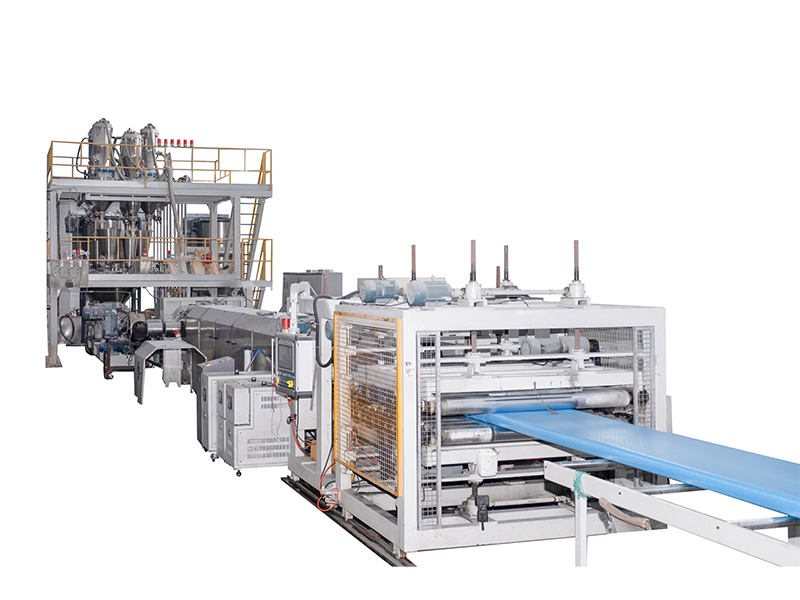
Specifying a line rather than buying board? The same four axes set the die, calibration and aging capacity — see how they are configured on the CO₂-foamed XPS production line.
Why the Grade String, Not the Density, Decides the Quote
Density is a process outcome, not a performance specification. Two boards leaving the same line at the same 32 kg/m³ can differ by more than 100 kPa in compressive strength, because strength comes from cell uniformity and skin integrity rather than from the weight of the sheet. When a purchase order names only a density, it leaves the actual performance undefined — and whichever board arrives technically satisfies the order.
The practical consequence is that the quotation should always be pinned to a grade string. Once the string is fixed, density becomes a process parameter the supplier manages, not a contractual number the buyer has to police.
GB/T 10801.2-2018: Four Classification Axes
The standard was published in 2018 and took effect on 1 July 2019, replacing the 2002 version. It classifies extruded polystyrene foam boards along four separate axes, and a complete specification normally combines all four.
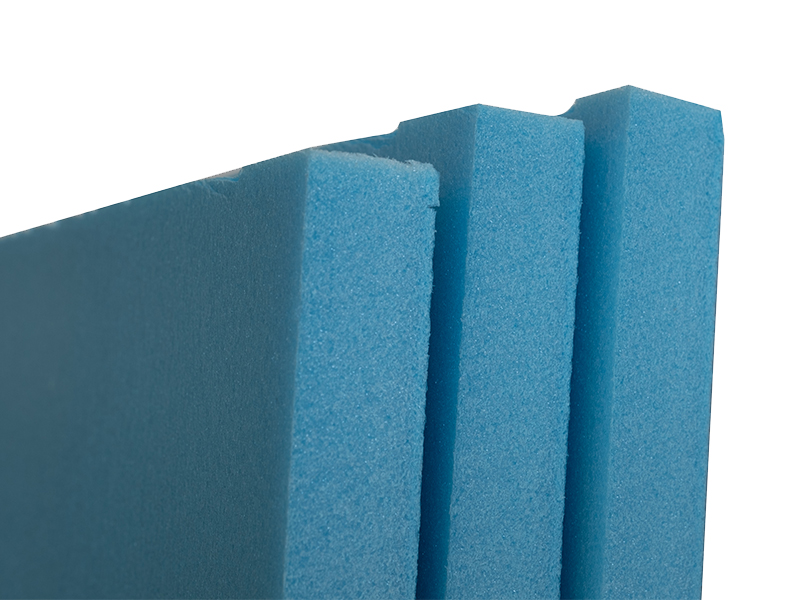
1. Compressive strength
Boards with an integral skin are graded from X150 to X900, where the number is the compressive strength at 10 % deformation in kPa. Boards without a skin use the W series.
- X150
- X200
- X250
- X300
- X350
- X400
- X450
- X500
- X700
- X900
- W200
- W300
X700 and X900 are the high-load classes; W200 and W300 are for boards without an integral skin.
2. Combustion performance
Declared as B1 or B2 under GB 8624, the general combustibility classification for building materials. B1 is the tougher of the two and is what most Chinese façade and interior specifications call for.
3. Thermal conductivity
Three classes only — 024 (≤ 0.024), 030 (≤ 0.030) and 034 (≤ 0.034), all in W/(m·K). There is no 038 class. A board declared at 0.038 is either a lower-performance product being described loosely, or a typo in the datasheet — either way it should be queried before the order is placed.
4. Edge profile
Four configurations: SS square edge, SL shiplap, TG tongue and groove, and RC rain channel. The profile is part of the grade, not an accessory, because it determines how the joints behave thermally and how water leaves the assembly.
How to Read a Full Grade String
Take a typical declaration and read it left to right:
Full designation: XPS-X250-SL-B1-024-GB/T10801.2-2018. If any one of those six positions is missing from a quotation, the specification is incomplete and should be sent back rather than interpreted.
Have a grade string you must meet? Send it over and we will confirm which line configuration holds it — or say plainly that it does not.
Check my specificationStandard Board Dimensions
| Dimension | Standard values (mm) | Notes |
|---|---|---|
| Length | 600 · 1,200 · 1,800 · 2,400 | 1,800 and 2,400 suit wall and roof modules |
| Width | 600 · 900 · 1,200 | 600 and 1,200 are the common widths |
| Thickness | 10 · 20 · 25 · 30 · 40 · 50 · 75 · 100 · 120 · 150 | 120 and 150 mm need a dedicated die |
These are standard catalogue sizes, not a limit on what a line can produce — the standard leaves other sizes to be agreed between buyer and supplier. When a project needs a non-standard thickness, the constraint is normally the die and the calibration section rather than the raw material.
The Four Edge Profiles
Joints are where insulation performance quietly leaks. The four profiles below exist to solve four different construction problems, and they are not interchangeable at the specification stage.
On inverted roofs and cold-storage floors, a square-edge joint is effectively an uninsulated strip. TG costs slightly more per square metre and removes that strip.
EN 13164 for European Buyers
European projects work off EN 13164, the harmonised European product standard, which sets out dimensional tolerances, thermal performance, compressive behaviour and water absorption for factory-made XPS products. It is a different declaration system from GB/T 10801.2, not a translation of it.
The practical point for a buyer comparing Chinese quotations is this: a board declared to GB/T 10801.2 is not automatically declared to EN 13164. The property sets overlap but are not identical, and each standard uses its own designation code. For a European project, ask for the EN 13164 declaration as a separate document and compare it property by property rather than converting class numbers across.
The codes do not map one-to-one. EN 13164 declares compressive behaviour as CS(10/Y) plus the stress in kPa — CS(10/Y)300, for example — while GB/T 10801.2 uses the X-class letter-number form. A GB X300 board and an EN CS(10/Y)300 declaration both quote 300 kPa at 10 % deformation, but each has to be substantiated by its own test report.
Where the two do line up cleanly is on the physical requirements that drive equipment design — thickness tolerance, flatness and dimensional stability. Those are the numbers a production line has to hold regardless of which standard the paperwork is written against.
Blowing Agents: What Actually Changed
XPS has been through three regulatory waves, and they explain why the blowing agent is now part of the commercial conversation rather than a factory detail.
| Driver | What it changed | Effect on specification |
|---|---|---|
| Montreal Protocol — HCFC phase-out | HCFC blowing agents progressively restricted | CO₂ and HFO systems moved from alternative to mainstream |
| HBCD flame-retardant phase-out | Brominated flame retardant withdrawn under POPs obligations | Flame-retardant packages reformulated; B1 declarations need re-testing |
| Building energy codes | China's building energy codes made the insulation grade a mandatory acceptance item rather than a recommendation | Insulation grade moved from recommendation to compliance item |
Supercritical CO₂ has an ozone depletion potential of zero, which is why it has become the default route for export-oriented lines. It also changes the process: the gas has to be brought above its critical point — 7.38 MPa at 31 °C — before injection, and the melt has to be held in a narrow window afterwards or the cell structure collapses.
What This Means When You Specify a Line
A grade on a datasheet is a promise about what the line can hold, repeatedly, over a full shift. Three process points decide whether that promise survives production:

- Thickness tolerance. The standard allows −1 / +2 mm below 75 mm and −1 / +3 mm at 75 mm and above, while length and width are allowed ±5.0 mm up to 1,000 mm, ±7.5 mm from 1,000 to 2,000 mm and ±10.0 mm beyond that. Thickness is the hard one, and it is produced in the calibration section, not at the die, which is why the number of rolls and the gap control matter more than the die width alone.
- Aging. Boards have to be cured before final trimming and packing — several days at ambient temperature, not hours — so residual blowing agent can diffuse out and the cell structure can stabilise. Cut-and-ship shortens the cycle and shows up later as thickness shrinkage on site.
- Compressive class stability. Holding X350 across a shift is a function of cell uniformity, which in turn depends on gas injection control and melt temperature stability. A line that can hit the class once is not the same as a line that holds it.
Frequently Asked Questions
What is the difference between X250 and X300 XPS?
The number is the compressive strength at 10 % deformation, in kPa. X250 is rated at 250 kPa, X300 at 300 kPa. The density can be identical between the two, because compressive strength comes from cell structure and skin integrity rather than from weight alone. Specify the class you need, not the density.
Can 0.034 and 0.038 both be called class 034?
No. Class 034 requires a declared thermal conductivity of 0.034 W/(m·K) or lower. A board at 0.038 does not meet class 034 and falls outside the 024, 030 and 034 grading set entirely. If a datasheet quotes a range such as 0.024 to 0.038, the upper bound has to be checked against the grade being claimed — the range is not the declaration.
TG or SL edges for roof insulation?
TG — tongue and groove — interlocks the board edges and removes the straight-through joint that acts as a thermal bridge, which is what inverted roofs and cold-storage floors need. SL — shiplap — forms a lapped joint that sheds water and is common on walls and pitched applications. RC — rain channel — is used where the joint has to drain. The choice follows the construction detail, not the board grade.
A board at 32 kg/m³ is which class?
Density does not determine the class. GB/T 10801.2-2018 grades boards by compressive strength, combustion performance, thermal conductivity and edge profile. Two boards at 32 kg/m³ can be X200 and X350 at the same time. Ask for the full designation string.
Are GB/T 10801.2 and EN 13164 interchangeable?
Not directly. The two standards test and declare different property sets, and each uses its own designation code. A board certified to one is not automatically certified to the other. For a European project, ask for the EN 13164 declarations alongside the GB data and compare property by property.
Need a Line That Holds the Grade, Not Just Reaches It
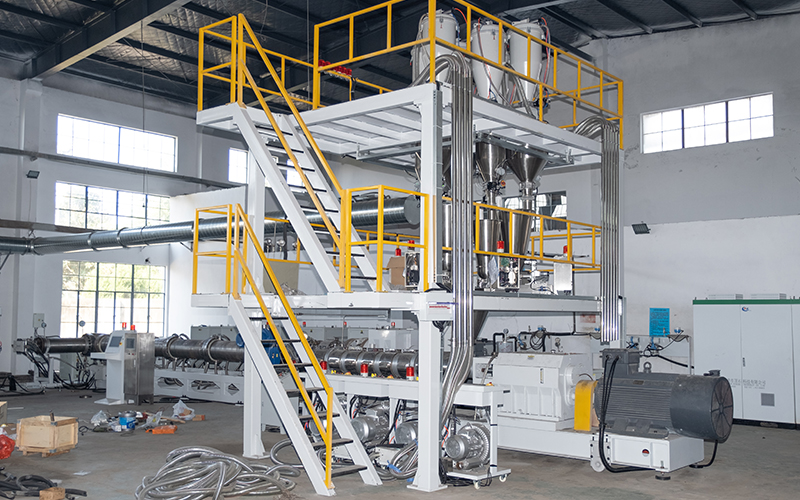
Tell us the class you are being asked to supply and the board dimensions, and we will come back with the line configuration that holds it — die, calibration section, aging capacity included.
Other lines we build: CO₂-free foamed XPS production line · PVC foam board production line
Send Your Specification Mingxin Zhi Machinery (MXZ) · Zhangjiagang, Jiangsu, China