


Views: 0 Author: Site Editor Publish Time: 2026-11-19 Origin: Site


We run EN 1603 ourselves before dispatch: 48 h at 70 °C, then 48 h at 70 °C and 90 % RH, with specimens re-stabilised at 23 °C and 50 % RH before the calipers come out.
Our acceptance line on a one-metre gauge is 1.5 mm/m in length, width and thickness for load-bearing and precision facade board; 5.0 mm/m is only acceptable for general void fill.
The stress we are chasing has two sources we can influence: molecular orientation frozen at the die lip, and the partial vacuum left inside closed cells as CO2 diffuses out faster than air diffuses in.
In our commissioning records, a correctly profiled three-zone annealing oven pulls post-cooling deformation from roughly 4.2 % down to 0.8 %. It cannot rebuild a collapsed cell or flatten a cambered board.
Soak time scales with thickness, not with line speed: 15–25 min for 20–40 mm board, 80–120 min for 130–150 mm board, at 86–88 °C.
We reject any ETICS batch above 5 mm bow over a 1000 mm length, because the adhesive bond fails under thermal cycling long before the board itself does.
XPS board shrinkage warpage control starts with a number we can defend, and the only number we trust is one taken on a marked specimen with a calibrated caliper. So we do not wait for a third-party inspector. When we hand over a line, our commissioning engineer runs EN 1603 first, in the client's own lab, and we keep the raw readings in the handover file alongside the 72-hour acceptance protocol we use for the mechanical side of the line.
The method is unforgiving about sequence. We cut three specimens per sample — one from the head, one from the middle, one from the tail of the run — and mark the measuring points with a fine punch before any conditioning, because a caliper reading taken 3 mm away from the original point on a foamed surface is a different reading. Then 48 hours at 70 ± 2 °C. Then a second 48-hour cycle at 70 °C and 90 ± 5 % RH. Then 24 hours back at 23 °C and 50 % RH, and only then do we measure.
Why the humidity cycle matters more than most buyers expect: dry heat relaxes frozen orientation, but humid heat attacks the cell walls at the same time. A board that passes the dry cycle and fails the humid one is telling us the cell structure is too weak to hold internal pressure once moisture softens the polymer at the surface. We have seen exactly this on lines where the die pressure was pushed up to gain output without touching the nucleating masterbatch dose.
We report the result as a percentage change in length, width and thickness, and we also convert it to millimetres per metre, because that is the unit a facade contractor uses when he decides whether a joint will close. Our internal chart of the two units sits in Table 1.
Application Category |
Conditioning Temp (°C) |
Relative Humidity (%) |
Duration (h) |
Max length/width change (%) |
Max thickness change (%) |
Equivalent (mm/m) |
|---|---|---|---|---|---|---|
Standard wall insulation |
70 ± 2 |
N/A |
48 |
≤ 5.0 |
≤ 5.0 |
≤ 5.0 |
Heavy-duty inverted roof |
70 ± 2 |
90 ± 5 |
48 |
≤ 2.0 |
≤ 2.0 |
≤ 2.0 |
Load-bearing substrate |
70 ± 2 |
N/A |
48 |
≤ 1.5 |
≤ 1.5 |
≤ 1.5 |
Precision EIFS panel |
70 ± 2 |
90 ± 5 |
48 |
≤ 1.0 |
≤ 1.0 |
≤ 1.0 |
We explain this to every new operator the same way: the board remembers the die. Polystyrene chains are dragged through a narrow lip at high shear, so they arrive at the die exit aligned along the machine direction. They want to coil back up, and if we cool the surface fast enough they never get the chance — the skin freezes them in their stretched state. That frozen orientation is the largest single contributor to longitudinal shrinkage, and it is why a board cut from a fast line shrinks more than one cut from a slow line at identical density.
The second source is a pressure problem rather than a polymer problem. CO2 leaves the cell far faster than air enters it, so the cell interior drops below atmospheric pressure and the walls have to carry the difference. If the cell walls are thick and uniform, they hold. If they are thin at the edges — which is what we find when the closed cell rate and water absorption are already marginal — they buckle, and the board loses thickness as well as length. That is why we treat cell structure and dimensional stability as one subject, not two.
The third factor is asymmetry. If the upper and lower calibrator plates run at different temperatures, the skin on one face freezes while the other is still relaxing. The board then relaxes unevenly through its thickness and comes out bowed rather than merely short. In our experience this is the most common cause of camber that appears two days after cutting, when the client has already stacked the pallets.
Stress origin |
Physical mechanism |
What it shows up as |
How we detect it |
|---|---|---|---|
High shear at the die lip |
Chains aligned in machine direction, frozen by fast skin cooling |
Longitudinal shrinkage on thermal exposure |
EN 1603 at 70 °C |
Asymmetric plate cooling |
Differential thermal contraction through the thickness |
Bow or camber two days after cutting |
EN 824 flatness check |
Fast CO2 diffusion |
Partial vacuum inside closed cells |
Thickness loss, edge crush |
Caliper tracking over 7 days |
Excess draw ratio |
Matrix over-stretched during expansion |
High MD shrinkage, sometimes TD growth |
Post-haul-off dimensional check |
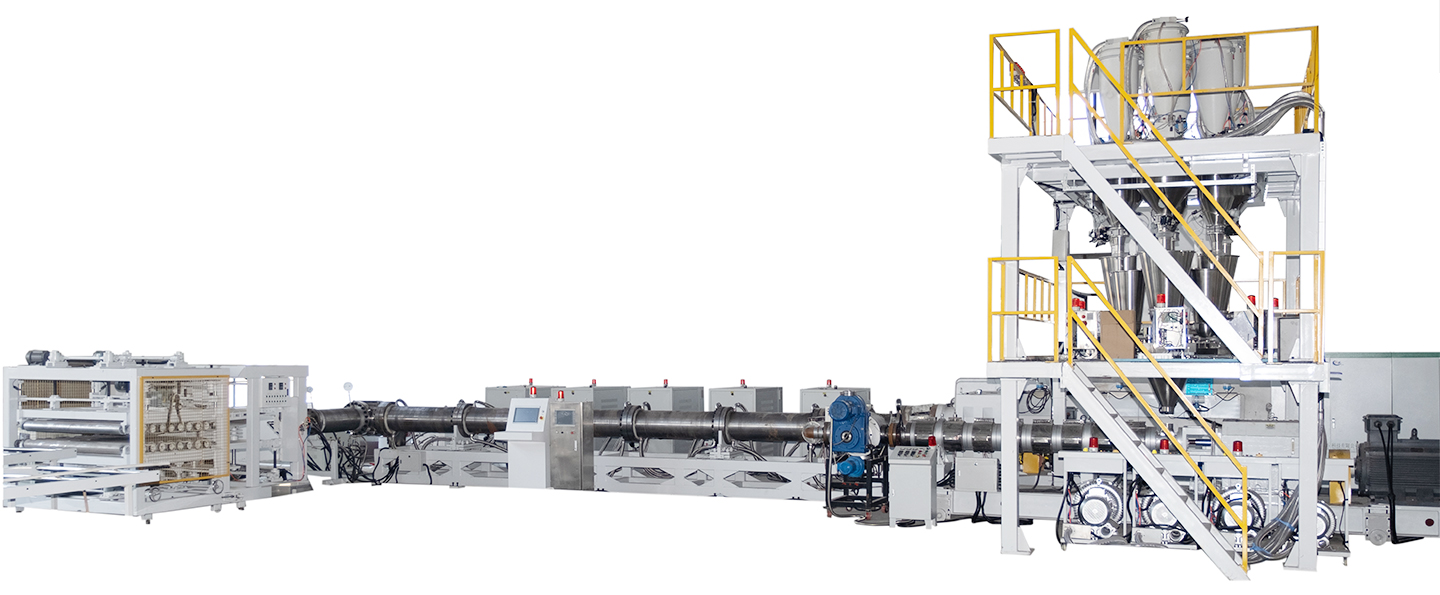
We size an annealing oven by residence time, not by length. Annealing works because we hold the board close to, but below, the glass transition temperature — the chains gain enough mobility to finish the relaxation they were denied at the calibrator, and gas diffusion accelerates so the internal vacuum equalises in hours instead of weeks. Nothing is added to the board; we are only giving it time at temperature that the line did not give it.
The profile has to follow thickness. A 20 mm board reaches core temperature in a few minutes, so a long soak buys nothing and only adds oven length. A 120 mm board is the opposite: XPS conducts heat poorly, so the skin can be at 86 °C while the core is still at 70 °C, and if we pull it out at that point the core keeps relaxing on the pallet and the stack sags. Our rule of thumb is that soak time roughly doubles for every 40 mm of additional thickness above 40 mm.
The cooling zone is where most of the rework we are called in to fix originates. If we drop the board temperature faster than about 3 °C per minute on a thick board, we re-introduce a skin-to-core gradient and undo the soak. The board looks flat at the end of the oven and bows on the third day.
Board thickness (mm) |
Heating zone (°C) |
Holding zone (°C) |
Holding time (min) |
Cooling gradient (°C/min) |
|---|---|---|---|---|
20 – 40 |
75 – 80 |
80 – 82 |
15 – 25 |
≤ 4.0 |
50 – 80 |
78 – 82 |
82 – 85 |
30 – 45 |
≤ 3.0 |
90 – 120 |
80 – 85 |
85 – 87 |
50 – 75 |
≤ 2.0 |
130 – 150 |
82 – 86 |
86 – 88 |
80 – 120 |
≤ 1.5 |
Above 88 °C at the surface we stop gaining relaxation and start losing cells: the walls soften, residual blowing agent expands a second time, and compressive strength falls away. We have measured a 15 % drop in compressive strength on a board that was soaked 4 °C too hot for 30 minutes — the board was flat, and we scrapped it anyway.
The honest limit of the process is worth stating plainly. Annealing removes orientation-driven shrinkage and speeds pressure equalisation. It does not repair a collapsed cell, it does not raise the density of an under-dense board, and it does not correct camber caused by unequal plate temperatures. If the calibrator is wrong, the oven will bake the error in.
Buyers often ask us to run the same oven recipe on a PS foam line, and we usually refuse. The two products look adjacent on a datasheet and behave very differently in an oven, because the density and the cell wall thickness set how fast heat and gas move.
Parameter |
XPS (extruded, CO2) |
PS foam (bead or low-density extruded) |
What it means for us |
|---|---|---|---|
Typical density |
28 – 45 kg/m³ |
15 – 30 kg/m³ |
Lower density PS heats through faster, soaks shorter |
Cell structure |
Closed, uniform, thin walls |
Coarser, more open at low density |
PS tolerates less internal vacuum, shrinks less but crushes easier |
Practical thickness |
20 – 120 mm |
20 – 60 mm typical |
Our 130–150 mm profile has no PS equivalent |
Holding zone temperature |
80 – 88 °C |
65 – 75 °C |
Running PS at 86 °C collapses the cell structure |
Dimensional target |
1.5 mm/m on load-bearing board |
2 – 5 mm/m depending on grade |
Tightening a PS spec to 1.5 mm/m usually means rejecting good board |
The boundary is simple: if the client is making thick, load-bearing insulation board and needs to hold a tight joint tolerance, the annealing oven is worth its floor space. If the client is making thin decorative or packaging profile at 20 kg/m³, an oven is the wrong investment — better to spend the money on a longer cooling conveyor and a stable die vacuum.
Warpage is not shrinkage. Shrinkage is a board getting smaller; warpage is a board leaving the plane. We check it on a granite reference surface with a wedge gauge, following EN 824, and we record bow, camber and twist separately because they have different causes and different fixes.
Bow along the machine direction usually points back to draw ratio or to a cooling gradient. Camber across the width usually points to unequal plate temperatures. Twist points at the haul-off: if the upper and lower caterpillar tracks run at slightly different speeds or clamp unevenly, the board leaves the line with a torsional set that no amount of oven time will remove.
For ETICS and thin-coat facade work we hold 5 mm over a 1000 mm length as the rejection line, and we prefer to be under 2 mm. The reason is mechanical rather than cosmetic: a warped board has to be forced flat against the substrate, so the adhesive is in permanent tension. Add summer thermal cycling and the bond fails at the edge first — and the failure is blamed on the adhesive, never on the board.
Application |
Max bow (mm/m) |
Max camber (mm/m) |
Max twist (mm/m) |
|---|---|---|---|
General void fill |
≤ 10.0 |
≤ 10.0 |
≤ 5.0 |
Standard roofing / flooring |
≤ 5.0 |
≤ 5.0 |
≤ 3.0 |
Precision ETICS / facade |
≤ 2.0 |
≤ 2.0 |
≤ 1.0 |
CNC-machined core |
≤ 1.0 |
≤ 1.0 |
≤ 0.5 |
On the market side, we align our inspection sheets with what the buyer's own standards body will ask for: EN 13164 for the CE marking route in Europe, ASTM C578 Type IV and Type X for North America, and GB/T 10801.2 for domestic and export-generic orders. On our CO2 lines we run 300–1200 kg/h at 600–1200 mm board width, which covers the 20–120 mm thickness band those standards address.
We judge a line on day three, not on the day it ships. If the board is still flat and still inside 1.5 mm/m after three days on the pallet, the cooling and the annealing were set correctly; if it has moved, no amount of paperwork will fix it later. That is why we insist on running EN 1603 in the client's lab during commissioning rather than accepting a supplier certificate — the test takes four days, and the argument it prevents can run for a whole season. When a batch does fail, we look at the oven profile and the plate temperatures before we touch the formulation, because in our records those two account for most of the deformation we are asked to correct.
Q: How long does an EN 1603 test take, and what result do you accept? A: Two 48-hour cycles — 70 °C dry, then 70 °C at 90 % RH — plus 24 hours re-stabilising at 23 °C and 50 % RH. We accept a batch when length, width and thickness change all sit inside the Table 1 limit for the application class, measured in millimetres per metre on a marked one-metre gauge.
Q: How much shrinkage can annealing actually recover? A: In our commissioning records, post-cooling deformation falls from about 4.2 % to 0.8 % on a correctly profiled three-zone oven. What stays uncorrected: collapsed cells, an under-dense board, and camber caused by unequal calibrator plate temperatures. Those are upstream problems and the oven only preserves them.
Q: Why does our board bow two days after cutting instead of at the end of the line? A: Because relaxation is time-dependent, not instant. The skin freezes first and the core keeps relaxing for 48–72 hours, so an asymmetric plate temperature profile shows up as camber only after the board has cooled through. We check bow again at 72 hours for exactly this reason, and we do not release a batch on the same-day reading.
Q: Will board produced in winter keep shrinking through its first summer? A: Yes, if it was not annealed. Cold weather slows relaxation rather than stopping it, so a board cut in January can still release stored stress in its first hot season. EN 1603 at 70 °C is the honest predictor; we also hold annealed board above 15 °C for two days before strapping it, which measurably reduces the drift we see on arrival.
Technical Specifications Inquiry
Target Output (kg/h):
Grid Voltage & Transformer (V / Hz / KVA):
Ambient Temperature & Humidity (Summer/Winter °C):
Available Factory Dimensions (L x W x H):


