


Views: 0 Author: Site Editor Publish Time: 2026-11-14 Origin: Site


Our comprehensive xps line operator training handover package ensures seamless equipment adoption. The standard program spans 7 consecutive days, covering 56 operational hours for a team of 4 local operators. The technical handover dossier includes 14 mechanical schematics, 8 electrical diagrams, and a 120-page maintenance manual specifying exact calibration protocols for supercritical CO2 injection systems.
Transitioning from installation to independent production requires a structured, rigorous knowledge transfer process. Operating a tandem extrusion line for XPS foam board production involves mastering thermodynamics, rheology, and precise mechanical control under continuous operational stress. Our 7-day curriculum is designed to bridge the gap between theoretical understanding and practical floor execution, particularly in regions where local operators may not have extensive prior experience with supercritical CO2 foaming technology or tandem extruder configurations.
The initial phase focuses on the fundamental architecture of the tandem extruder setup. Operators are introduced to the primary twin-screw extruder (typically 75mm or 85mm diameter with a length-to-diameter ratio of 32:1 to 36:1) and the secondary single-screw cooling extruder (150mm or 200mm diameter with an L/D of 30:1 to 34:1). The training emphasizes the function of gravimetric dosing units, which must maintain a feeding accuracy of ±0.5% for the primary polystyrene resin, nucleating agents (like talc), flame retardants (such as environmentally friendly brominated compounds), and color masterbatches.
We detail the pneumatic conveying sequences and the critical role of the dehumidifying dryers. Moisture control is paramount; the target dew point for the drying air is typically -40°C. If the ambient humidity exceeds 65% RH, the drying cycle time must be extended by 20 to 30 minutes to prevent moisture-induced surface defects or internal void formations in the final foam board. Operators learn to calibrate the loss-in-weight feeders, interpret the load cell feedback loops, and clean the rotary valves to prevent material bridging. We also cover the proper handling of recycled EPS/XPS granules and the maximum permissible blending ratios (usually capped at 30% to maintain mechanical integrity) to ensure consistent melt viscosity.
This module addresses the core complexity of the XPS process: the injection and homogeneous dispersion of physical blowing agents. We cover the operational parameters for CO2 and ethanol injection pumps, emphasizing the high-pressure critical state requirements necessary for cellular nucleation.
Operators learn to read the melt pressure transducers and thermocouple arrays installed along the primary extruder barrel. The mixing zone configuration, utilizing specialized kneading blocks and reverse flight elements, is explained in the context of creating a uniform polymer-gas solution.
IF the primary extruder melt temperature drops below 195°C before the injection port, THEN the CO2 will not achieve proper supercritical dispersion, leading to large, irregular cell structures and poor compressive strength.
IF the injection pressure fluctuates by more than 2.5 MPa, THEN the metering pump seals must be inspected, the inlet filter screen must be purged, and the check valve at the injection port must be checked for polymer backflow.
IF the static mixer temperature exceeds 135°C, THEN premature foaming may occur within the transfer pipe, causing severe surface corrugation on the extruded board.
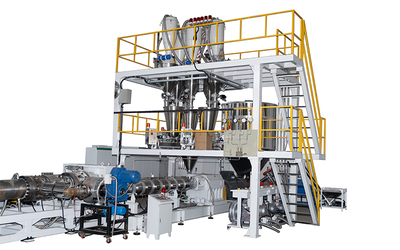
We utilize the HMI panel to simulate injection failures and train operators on the emergency shut-off sequence for the high-pressure gas lines. The cooling capacity of the secondary extruder is thoroughly analyzed. We teach operators how to maintain a uniform, controlled melt temperature drop from approximately 220°C down to 110°C - 118°C before reaching the slot die head.
The focus shifts to the slot die, the calibration table, and the downstream haul-off mechanisms. Operators practice adjusting the flexible die lip using the array of push-pull bolts to control the board's initial thickness and width (accommodating ranges from 20mm to 120mm in thickness and 600mm to 1200mm in width). They learn the complex correlation between die head pressure (typically maintained between 80 to 120 bar), melt flow rate, and the resultant foam board density.
The calibration section training involves managing the vacuum forming zones and the water cooling circuits. Operators are instructed on setting the precise clearance between the upper and lower PTFE-coated calibration plates. Incorrect clearance can lead to surface friction burns, premature expansion, or inadequate cooling resulting in board warping.
The training includes setting the speed ratios for the primary and secondary haul-off units to maintain constant web tension. We explain the function of the annealing oven, guiding operators on how to set the temperature gradient (e.g., from 80°C down to 40°C over 10 meters) to eliminate internal stress accumulation in the foam structure, ensuring long-term dimensional stability. We also cover the operation of the longitudinal and transverse cutting saws, emphasizing blade maintenance and dust extraction efficiency.
The final day is dedicated to autonomous operation under the strict supervision of our commissioning engineers. The local team must independently execute a cold start-up sequence, which involves a specific heating protocol taking 3 to 4 hours to avoid thermal shock to the extruder barrels. They must achieve steady-state production within 45 to 60 minutes of introducing the blowing agents and perform a planned, controlled shut-down.
Quality control protocols are tightly integrated into this phase. Operators use digital calipers, micrometers, and precision density scales to verify that the produced boards meet the required specifications (e.g., a target density of 32-35 kg/m³, compressive strength > 300 kPa, thermal conductivity < 0.030 W/m·K). Any deviations from these parameters trigger a root-cause analysis exercise based on the provided troubleshooting manuals. They are trained to perform initial cell structure analysis using a magnifying glass to check for uniform, closed-cell formation.
A critical component of our comprehensive services is equipping your maintenance team with the diagnostic skills necessary to minimize unplanned downtime. The handover package includes a highly detailed troubleshooting matrix that cross-references mechanical symptoms with electrical faults, providing clear, step-by-step diagnostic pathways.
The extruder drive systems, especially on the primary twin-screw unit, are subjected to extreme torque loads during the plasticization phase and cold start-ups. Our training covers the vibration analysis and thermal monitoring of the reduction gearboxes and thrust bearings.
Symptom |
Primary Diagnostic Check |
Secondary Action |
|---|---|---|
High Main Motor Current (>150A) |
Check melt temperature profile in Zone 1-4. Ensure no cold spots exist. |
Verify screen changer differential pressure. Replace screen if ΔP > 15 MPa. |
Gearbox Vibration (>4.5 mm/s) |
Inspect lubrication oil level, pressure, and viscosity. |
Check motor-to-gearbox flexible coupling alignment using a dial indicator. |
Screw Surging (RPM fluctuation) |
Verify gravimetric feeder stability and material bulk density. |
Inspect for bridging in the water-cooled feed throat. Adjust throat cooling water flow. |
Unusual Thrust Bearing Noise |
Check bearing temperature sensor output on PLC. |
Schedule immediate inspection; potential lubrication failure or mechanical overload. |
The barrel heating system relies on a complex network of ceramic or cast aluminum heater bands, individually controlled by SSRs responding to PID algorithms. Operators are trained to identify localized temperature drops or overshoots using handheld thermal imaging cameras or by monitoring the PID controller output percentages on the central PLC screen.
IF a specific barrel heating zone fails to reach the setpoint within 20 minutes of startup, THEN the operator must first verify the SSR switching status via the control cabinet's indicator LED.
IF the SSR LED is active but no heating occurs, THEN a licensed electrician must use a multimeter to check the continuity of the heater band element and the wiring integrity.
IF a zone continually overshoots the set temperature despite the SSR being off, THEN the barrel cooling fan or the internal water-cooling loop (if equipped) for that specific zone must be inspected for blockages or valve failures.
We provide specific, highly detailed electrical schematics that map every individual thermocouple input and SSR output to the exact corresponding Siemens S7-1500 PLC module terminal, significantly accelerating the fault-finding process.
Accurate, reliable melt pressure readings are vital for the safety and process stability of the XPS line. The handover package includes rigorous instructions for calibrating the Dynisco or Gefran pressure transducers. Calibration must be performed at zero pressure during a hot, completely empty barrel state to account for thermal expansion of the sensor diaphragm.
Operators learn to recognize sensor drift and signal interference. If a pressure transducer outputs a noisy, fluctuating 4-20mA signal, the training manual directs the technician to check the grounding of the sensor shield, inspect the cable routing away from high-voltage VFD lines, and ensure the sensor tip is not obstructed by degraded, carbonized polymer material.
Safety is paramount when operating heavy machinery that handles high temperatures (up to 250°C), high pressures (up to 300 bar), and potentially combustible physical blowing agents like ethanol, dimethyl ether (DME), or butane. Our training program enforces strict, uncompromising safety protocols that must be adhered to without exception.
The storage, metering, and injection of supercritical fluids and high-pressure liquefied gases require specialized knowledge and extreme caution. The training extensively covers the safe operation of the CO2 booster pumps, the diaphragm metering pumps, and the maintenance of high-pressure bladder accumulators.
Daily Inspection: Visual and physical check of all high-pressure flexible hoses, rigid stainless steel tubings, and compression fittings for signs of abrasion, blistering, or micro-leaks. Verification of safety relief valve inspection tags and set pressures.
Leak Detection: Intensive training on the use, calibration, and placement of portable and fixed gas detectors around the injection port, the static mixer flange, and the die head.
Emergency Venting: Step-by-step procedures for safely venting high-pressure gas from the extruder barrel in the event of an unexpected power failure, a sudden extruder jam, or a rupture disk activation. Operators are trained on the exact sequence of valve operations to depressurize the system without causing polymer blow-back.
When utilizing flammable blowing agents, the risk of ignition must be aggressively mitigated through both engineering controls and strict operational procedures. The handover package details the required ventilation exchange rates for the production hall and verifies the installation of explosion-proof (ATEX certified) electrical fittings, motors, and sensors in designated hazardous zones around the die head and calibration table.
IF the ambient concentration of ethanol or butane vapor exceeds 20% of the Lower Explosive Limit (LEL) as detected by the area sensors, THEN the safety interlock system will automatically halt the extruder drive, shut off blowing agent injection, and activate the emergency high-capacity exhaust fans.
IF a localized thermal runaway or a flash fire is detected in the die head area by UV/IR flame detectors, THEN operators must immediately trigger the dry powder or CO2 fire suppression system integrated into the die enclosure and evacuate the immediate vicinity.
Routine maintenance tasks, such as changing the screen pack, cleaning the die lip, or replacing downstream cutting blades, require strict, non-negotiable LOTO procedures. Operators and maintenance personnel are trained to isolate the main electrical power supply at the breaker, lock the disconnect switch with a personal padlock, and verify a zero energy state using established multi-point testing protocols before initiating any mechanical work on the rotating equipment, hydraulic units, or pneumatic cylinders.
To ensure long-term operational reliability and minimize lifecycle disruptions, the handover documentation includes an exhaustive, itemized spare parts catalogue and a rigorous preventative maintenance schedule. This proactive approach ensures that consumable items are replaced before catastrophic failure and critical components are inspected at appropriate intervals. For a broader understanding of establishing a new facility, refer to our comprehensive guide on site preparation requirements for XPS lines.
The spare parts catalogue is systematically categorized by operational criticality, expected wear rate, and supplier lead time. We define essential consumables that must be kept in local, on-site inventory to prevent extended, multi-day production halts.
Critical Spares (Mandatory Stock On-Site): Thermocouples (Type J/K), solid-state relays, safety rupture disks (bursting discs), primary melt pressure transducers, various screen pack meshes (e.g., 40, 60, 80 mesh), specialized high-temp O-rings and seals for the injection valves, and spare cutting saw blades.
Strategic Spares (Monitor Condition & Plan Procurement): Extruder screw elements (especially kneading blocks which wear faster), bimetallic barrel liners, primary motor cooling fans, VFD control boards, and primary gearbox bearings.
For detailed insights into establishing a robust, data-driven inventory strategy for these highly specialized components, see our dedicated article on after-sales support and spare parts planning.
The technical handover package dictates specific maintenance activities based on actual operating hours, tracked by the main PLC. This structured approach prevents premature wear, maintains the precision of the extrusion line, and extends the overall mean time between failures (MTBF).
Maintenance Interval |
Required Actions |
Component Focus |
|---|---|---|
Weekly (168 Hours) |
Inspect vacuum pump oil levels, clean water chiller filters, verify heater band clamping tightness, check pneumatic line lubricators. |
Calibration table vacuum system, cooling circuits, extruder barrel heating zones. |
Monthly (720 Hours) |
Grease extruder drive couplings with high-temp lithium grease, inspect haul-off caterpillar rubber pads for wear, calibrate online thickness gauges, test safety interlocks. |
Drive systems, downstream haul-off equipment, measurement devices, safety relays. |
Quarterly (2160 Hours) |
Perform vibration spectrum analysis on primary and secondary gearboxes, physically inspect screw tips for wear during a scheduled pull, check PLC battery status and torque terminal connections. |
Gearboxes, extrusion screws, electrical control cabinets. |
Annually (8640 Hours) |
Comprehensive laser alignment check of the entire extrusion line, ultrasonic thickness testing of high-pressure barrels to detect internal wear, replace primary metering pump diaphragms and seals. |
Extruder alignment, structural integrity of pressure vessels, fluid injection systems. |
By rigorously adhering to these schedules and utilizing the detailed documentation provided in the handover package, your local engineering team can maintain optimal equipment performance, ensure consistent product quality, and maximize the operational lifespan of the machinery.
Our commitment to your industrial manufacturing project extends far beyond the physical installation and cold commissioning of the machinery. The intensive 7-day operator training curriculum and the exhaustive technical handover package are explicitly engineered to empower your local workforce. By providing deep, actionable insights into melt thermodynamics, rigorous safety protocols, and structured, logical troubleshooting methodologies, we ensure that your team can operate the complex tandem extrusion line with absolute confidence and precision. This comprehensive, methodical knowledge transfer is the most essential element for maintaining consistent product quality and maximizing the operational uptime of your XPS manufacturing facility.
Please provide the following operational parameters so our engineering team can tailor the equipment specifications, site layout, and training modules to your exact site conditions:
Target Production Capacity: [ ] kg/h
Power Grid Specifications: [ ] V / [ ] Hz / [ ] KVA Transformer Capacity
Ambient Environment: Summer Max [ ] °C / Winter Min [ ] °C
Available Factory Dimensions: [ ] L x [ ] W x [ ] H (meters)
Tell us these four parameters and we will size the line for your site:
Target Output (kg/h):
Grid Voltage & Transformer (V / Hz / KVA):
Ambient Temperature & Humidity (Summer/Winter °C):
Available Factory Dimensions (L x W x H):
Q: What documents come with the line? A: The technical handover package includes comprehensive mechanical assembly drawings, detailed electrical schematics, PLC logic flowcharts, a 120-page operation and maintenance manual, and a categorized spare parts catalogue with precise OEM specifications.
Q: How many days of training? A: Our standard operator training program consists of 7 consecutive days on-site, providing 56 hours of intensive, hands-on instruction covering system architecture, process control thermodynamics, troubleshooting, and autonomous production runs.
Q: Who trains the second shift? A: We train your primary operators and maintenance leads using a train-the-trainer methodology. The handover package includes structured training materials and assessment checklists to enable your core team to effectively and safely onboard subsequent shifts.


