


Views: 0 Author: Site Editor Publish Time: 2026-11-16 Origin: Site


At 10% deformation, XPS compressive strength typically ranges from 250 kPa to 700 kPa, heavily depending on the manufacturing density and cellular orientation. Long-term creep over 50 years usually results in less than 2.0% thickness reduction under a continuous dead load of 130 kPa, ensuring permanent structural stability in heavy-load applications.
When specifying extruded polystyrene (XPS) foam boards for structural applications such as inverted roofs, parking decks, or industrial floors, evaluating the mechanical resistance under load is the most critical engineering parameter. The internationally recognized standard for determining the compression behavior of thermal insulating products is EN 826. This standardized testing protocol ensures that the mechanical data provided by XPS manufacturers is consistent and reflective of the material's actual capability to withstand compressive forces without catastrophic structural failure.
The EN 826 testing procedure involves subjecting a rectangular XPS specimen to a uniformly distributed compressive force applied at a constant rate of displacement. The standard defines the compressive strength as the ratio of the maximum compressive force to the initial cross-sectional area when deformation reaches 10% of the initial thickness, or at the yield point if yielding occurs earlier. For XPS rigid foam, the structural matrix typically exhibits a distinct linear elastic region followed by a plateau where the cellular structure begins to buckle. Because catastrophic failure is rarely instantaneous, the 10% deformation mark serves as a practical, conservative threshold for engineering calculations.
The initial segment of the stress-strain curve represents the elastic deformation phase, where the solid polymer struts and walls of the closed cells bend and stretch reversibly. The slope of this linear elastic region determines the compressive modulus of elasticity. As the applied load increases beyond the elastic limit, the foam transitions into the plateau regime. In this phase, localized buckling of the cell walls occurs. The trapped blowing agent gases within the closed cells also undergo compression, contributing pneumatic resistance to the mechanical stress.
The precision of the testing apparatus and the conditioning of the samples significantly influence the accuracy of the EN 826 results. Specimens must be conditioned in a controlled environment to eliminate transient thermal or moisture-induced dimensional changes before testing. The testing machine must possess rigid loading plates that remain strictly parallel to prevent localized stress concentrations, which could trigger premature crushing and artificially lower the recorded compressive strength.
If-Then Rules for EN 826 Testing Variables:
If the crosshead speed exceeds the specified 0.1 d/min (where d is the initial thickness of the specimen), then the dynamic impact effects will artificially inflate the apparent compressive strength due to the viscoelastic stiffening of the polystyrene polymer chains under rapid strain rates.
If the test specimen surfaces are not perfectly parallel and flat (deviation > 0.5 mm), then asymmetrical loading will induce shear stresses, causing premature localized cell buckling and reducing the measured compressive strength at 10% deformation by up to 12%.
If the sample dimensions are too small, then the edge effects, where ruptured surface cells offer zero resistance, will disproportionately lower the overall strength reading compared to standard specimens.
Parameter |
EN 826 Requirement |
Impact of Deviation |
|---|---|---|
Specimen Geometry |
100 mm x 100 mm minimum |
Undersized samples yield false low strength values |
Loading Rate |
0.10 * thickness per minute |
Rapid loading causes apparent viscoelastic stiffening |
Plate Parallelism |
< 0.1% deviation |
Non-parallel plates induce premature shear buckling |
Conditioning Temp |
23°C ± 2°C |
Elevated temperatures soften the polymer matrix |
By rigorously adhering to the EN 826 protocol, manufacturers can classify their XPS products into standardized compressive strength categories, such as CS(10\Y)250, CS(10\Y)300, CS(10\Y)500, or CS(10\Y)700, where the numerical value represents the compressive stress in kilopascals (kPa) at 10% deformation.
The mechanical resilience of an extruded polystyrene board is intrinsically linked to its apparent density. In extrusion technology, achieving a specific compressive strength target requires precise manipulation of the polymer melt rheology, blowing agent dispersion, and the thermodynamic phase separation during the foaming process. For an in-depth understanding of the extrusion mechanics that govern these parameters, refer to our comprehensive guide on How Is XPS Foam Board Density Stabilized During Production.
The correlation between density and compressive strength in XPS is positive, but it is not strictly linear. It follows a power-law relationship governed by the cellular morphology. As the density increases, the volume fraction of the solid polystyrene polymer relative to the gaseous voids increases. This translates microscopically into thicker cell walls and more robust cell struts. During a compression event, these thicker solid polymer structures require exponentially higher force to initiate buckling.
However, density alone is not the sole determinant of compressive strength; the geometric shape and orientation of the cells play an equally critical role. During the extrusion process, the foaming polymer melt is pulled through a calibration unit in the machine direction (MD). This mechanical drawing elongates the expanding cells, transforming them from perfect spheres into anisotropic, elongated polyhedrons. The compressive strength measured in the thickness direction (ZD)—the direction parallel to the typical load application in flooring or roofing—is heavily dependent on the orientation of the cell struts relative to this Z-axis.
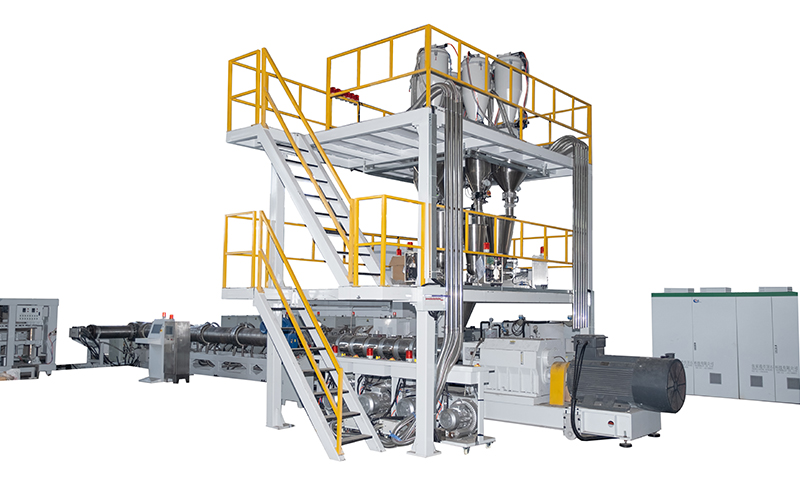
Advanced CO2 foaming lines are specifically engineered to control the tri-axial expansion of the foam, ensuring a high degree of isotropy or purposefully orienting the cellular struts to maximize Z-axis strength.
If-Then Rules for Density-Strength Dynamics:
If the board density increases by 10% while maintaining constant cell size and orientation, then the compressive strength in the thickness direction will typically increase by approximately 15% to 18%, following the nonlinear power-law scaling of cellular solid mechanics.
If the primary blowing agent relies heavily on rapidly diffusing gases without sufficient polymer melt cooling at the die lip, then the resulting large, thin-walled cells will yield a lower compressive strength despite maintaining the identical overall board density, because the strut thickness is compromised.
XPS Density (kg/m³) |
Typical Cell Size (mm) |
Predicted Compressive Strength at 10% Deformation (kPa) |
|---|---|---|
28 - 30 |
0.15 - 0.25 |
200 - 250 |
32 - 35 |
0.12 - 0.20 |
300 - 350 |
38 - 42 |
0.10 - 0.18 |
500 - 600 |
45 - 50 |
0.08 - 0.15 |
700 - 800 |
To manufacture high-strength boards required for demanding Scandinavian engineering projects, the production line must utilize specialized screw configurations that ensure homogeneous dispersion of nucleation agents and maintaining high melt pressures prior to the foaming die.
While the compressive strength at 10% deformation provides a baseline for short-term loading capacity, engineering applications involving continuous, permanent loads—such as building foundations, ballasted roofs, and heavy machinery platforms—require a deep understanding of the material's long-term viscoelastic behavior. This phenomenon is known as compressive creep. Polystyrene is an amorphous thermoplastic. When subjected to a constant stress below its yield point over an extended period, the polymer chains slowly disentangle and slip past one another, resulting in a gradual, time-dependent increase in strain.
For structural applications, especially in environments facing heavy constant loads like those found in underfloor heating systems integrated with thick concrete screeds, excessive creep can lead to unacceptable floor settlement, cracking of the rigid finishes, and failure of the internal piping networks. For further insights into how XPS integrates into these demanding applications, refer to our technical outline on how board density is stabilised during production.
The standard methodology for assessing the compressive creep of thermal insulation products is EN 1606. This grueling test involves subjecting XPS specimens to constant compressive stresses under precisely controlled conditions for up to 1,000 days. The data collected is mathematically extrapolated using standard viscoelastic models to predict total deformation over a design service life, which is typically defined as 50 years.
The total creep deformation comprises three distinct phases: primary creep, secondary creep (a steady-state phase with a constant deformation rate), and tertiary creep. For XPS used in construction, the applied design load must be kept sufficiently low to ensure the material remains indefinitely within the secondary creep phase.
The internal gas pressure within the closed cells also significantly influences the long-term creep behavior. Immediately after production, the cells contain a mixture of blowing agents and air. Over time, as blowing agents diffuse out and atmospheric air diffuses in, the internal pneumatic pressure equilibrates. To ensure that the internal gas composition remains stable and the mechanical support provided by the cellular gas pressure does not degrade prematurely, a highly intact cellular structure is paramount. Read more about achieving this microstructural integrity in our analysis of XPS Closed Cell Rate and Water Absorption Control.
If-Then Rules for Long-Term Creep Behavior:
If the continuous dead load applied to the XPS board exceeds 30% to 35% of its initial nominal compressive strength (at 10% deformation), then the polymer matrix will eventually transition into non-linear tertiary creep.
If the operating temperature of the XPS board increases continuously by 15°C, then the secondary creep rate will accelerate significantly due to the increased thermal mobility of the polystyrene polymer chains, requiring a corresponding reduction in the allowable structural design load.
Nominal Strength (kPa at 10% def.) |
Max Recommended Continuous Load (kPa) |
Projected 50-Year Creep Deformation (%) |
|---|---|---|
CS(10\Y)300 |
100 - 110 |
< 1.5% |
CS(10\Y)500 |
160 - 180 |
< 1.5% |
CS(10\Y)700 |
225 - 250 |
< 2.0% |
Consequently, structural engineers typically apply a safety factor of roughly 3.0 to the initial compressive strength when determining the maximum allowable continuous dead load.
The extrusion process inherently produces XPS boards with a distinct, continuous surface skin. When the hot, foaming polymer melt exits the extrusion die and enters the calibration mechanism, the outermost layers of the extrudate come into direct contact with the temperature-controlled calibration plates. This rapid thermal quenching solidifies the surface polymer before the cells have the opportunity to fully expand. The result is a dense, microcellular, and relatively thick outer skin enclosing the lower-density core foam.
This natural surface skin is not merely an aesthetic feature; it acts as a highly rigid, load-distributing membrane that fundamentally alters the flexural and compressive mechanics of the board. From an engineering mechanics perspective, a skin-on XPS board behaves analogously to an I-beam or a structural sandwich panel. The high-density outer skins act as the rigid flanges, resisting tensile and compressive bending stresses, while the lighter foam core acts as the web.
When a localized, concentrated compressive load is applied to a skin-on XPS board, the rigid surface skin effectively disperses the stress over a much wider area of the underlying core foam. This load distribution prevents localized cell crushing and significantly increases the apparent point-load resistance of the board. In contrast, if the board is planed or milled to remove the skin, the concentrated load acts directly upon the exposed, lower-density core cells, leading to immediate localized yielding and a lower overall compressive resistance.
If-Then Rules for Surface Skin Mechanics:
If the extrusion calibration cooling rate is increased drastically, then the thickness and density of the surface skin will increase, resulting in a higher overall flexural modulus and an enhanced apparent compressive strength for the final product.
Surface Condition |
Core Density (kg/m³) |
Flexural Strength (kPa) |
Apparent Point-Load Resistance |
|---|---|---|---|
Natural Extrusion Skin |
32 |
> 400 |
Excellent load distribution |
Lightly Sanded / Grooved |
32 |
~ 350 |
Moderate load distribution |
Deep Planed (Skinless) |
32 |
< 300 |
Prone to localized indentation |
Furthermore, the continuous surface skin significantly enhances the board's resistance to moisture penetration and freeze-thaw degradation. The dense, non-porous skin acts as the primary barrier against capillary water uptake. For applications in extreme Nordic environments where the boards are exposed to ground moisture and sub-zero temperatures, preserving the integrity of this extrusion skin ensures that the long-term compressive strength and creep resistance are not compromised by ice lens formation within the cellular matrix.
Evaluating the compressive strength at 10% deformation provides the essential baseline for determining the suitability of XPS foam boards in load-bearing environments. However, true structural stability over a 50-year lifespan requires a comprehensive understanding of polymer creep behavior under continuous dead loads, the precise correlation between extrusion density and cellular orientation, and the critical structural role of the dense extrusion skin. By mastering the rheological controls within the extrusion process, manufacturers can engineer XPS products capable of sustaining immense static and dynamic forces without catastrophic deformation or dimensional compromise. To engineer the perfect XPS production line tailored to your specific mechanical requirements, please provide your operational parameters below.
Tell us these four parameters and we will size the line for your site:
Target Output (kg/h):
Grid Voltage & Transformer (V / Hz / KVA):
Ambient Temperature & Humidity (Summer/Winter °C):
Available Factory Dimensions (L x W x H):
Q: What compressive strength at 10% deformation? A: At 10% deformation, XPS boards typically exhibit a compressive strength ranging from 250 kPa for standard insulation grades up to 700 kPa for heavy-duty infrastructure applications, depending strictly on the engineered density and cellular structure orientation.
Q: Does density predict strength? A: Yes, apparent density acts as the primary indicator of strength, following a non-linear power-law relationship. Higher density means thicker polymer cell walls and struts, which exponentially increases the resistance against mechanical buckling under load.
Q: How much creep over 50 years? A: For an XPS board subjected to a continuous dead load not exceeding roughly 30% of its initial compressive strength, the total creep deformation is engineered to remain below 2.0% over a 50-year structural service life.
Target capacity (kg/h): [Input Field] Grid voltage and transformer (V / Hz / KVA): [Input Field] Environmental temperature and humidity (Summer/Winter °C): [Input Field] Factory available dimensions (L x W x H): [Input Field]


