


Views: 0 Author: Site Editor Publish Time: 2026-08-17 Origin: Site


Transitioning away from fluorocarbons like HCFCs and HFCs is now a strict regulatory necessity for modern manufacturers. However, utilizing CO2 as your primary blowing agent introduces severe operational volatility into your daily plant operations. CO2 possesses an extremely narrow thermodynamic operating window compared to legacy gases. Without the correct foundational facility infrastructure, you inevitably face unacceptable scrap rates, highly uneven board density, and frequent cell collapse.
This guide provides technical buyers and production directors with a realistic, compliance-aware framework for evaluating readiness. We outline exactly what is needed to support a high-yield CO2 XPS production line. You will discover the critical utility demands, gas handling safety protocols, and necessary machinery upgrades. Read on to master these foundational plant conditions before finalizing your next major equipment procurement.
Stable CO2 foaming requires industrial-grade, continuous cooling capacity that far exceeds legacy freon lines.
High-pressure gas dosing systems demand specialized storage, rigorous safety ventilation, and uninterrupted power to prevent catastrophic pressure drops.
Achieving premium closed cell XPS foam with CO2 relies on specific twin-screw extruder configurations and static mixing capabilities.
Facility audits must evaluate floor space, structural load for heavier chilling equipment, and ambient temperature controls before finalizing equipment procurement.
Global environmental mandates continue driving the shift toward zero-ozone depletion potential (ODP) blowing agents. Regulators also demand low global warming potential (GWP) alternatives across the plastics sector. These compliance requirements force manufacturers to adopt CO2 XPS extrusion technology. Ignoring this shift invites severe regulatory penalties and loss of market access.
Despite clear environmental benefits, processing CO2 remains fundamentally harder than handling traditional gases. We must address its lower solubility in polystyrene melt. CO2 acts as a powerful plasticizer but resists blending smoothly into the polymer matrix. Once released from internal pressure, it exhibits rapid expansion rates. The gas flashes violently as it exits the die head. Furthermore, CO2 demonstrates strict temperature dependency. Even minor temperature fluctuations cause the gas to transition unpredictably between liquid and supercritical states.
To mitigate these risks, production directors must define clear success criteria for line stability. A stable plant environment guarantees four operational benchmarks:
Consistent Density: Maintaining a uniform weight profile across the entire board width.
Uniform Cell Structure: Preventing pinholes, blowholes, or micro-fractures inside the core.
Dimensional Stability: Ensuring boards do not warp, shrink, or crown after final calibration.
Minimized Start-Up Scrap: Reaching steady-state production quickly to protect raw material margins.
Cooling water infrastructure represents the number one operational bottleneck during plant upgrades. CO2 requires highly aggressive cooling at the secondary extruder. You must extract massive amounts of heat to maintain adequate melt strength. If the polymer melt remains too hot, it cannot contain the violent expansion of the CO2 gas. Cell walls rupture immediately, creating useless scrap.
Evaluating existing chiller capacity is a mandatory first step. Legacy systems designed for freon rarely handle the thermal load of a modern CO2 XPS production line. You must assess chilled water flow rates, strict temperature stability, and system redundancy. The following table highlights baseline metrics you should verify before installation.
Utility Metric | Legacy Requirement (Freon) | CO2 Requirement | Impact on Production |
|---|---|---|---|
Water Temperature Stability | ± 3.0 °C | ± 0.5 °C | Prevents polymer viscosity fluctuations. |
Flow Rate Redundancy | Single pump systems | Dual/Standby pump systems | Guarantees continuous cooling during maintenance. |
Chiller Capacity Scaling | Standard ton ratings | 2x to 3x higher ton ratings | Removes excess heat generated by severe shearing. |
Secondary Heat Exchangers | Optional | Mandatory | Protects primary loops from contamination. |
Power supply quality ranks equally high on the infrastructure checklist. High-pressure CO2 dosing pumps operate under extreme physical stress. They demand flawless electrical consistency. Minor voltage fluctuations easily disrupt these dosing pumps. When voltage drops, pump cavitation occurs, starving the extruder of blowing agent.
Uninterrupted power prevents polymer freezing inside the die. If grid power fails suddenly, the polymer melt cools rapidly. It solidifies inside the intricate flow channels of the die head. Clearing a frozen die requires days of intense labor and risks permanent mechanical damage to the tooling.
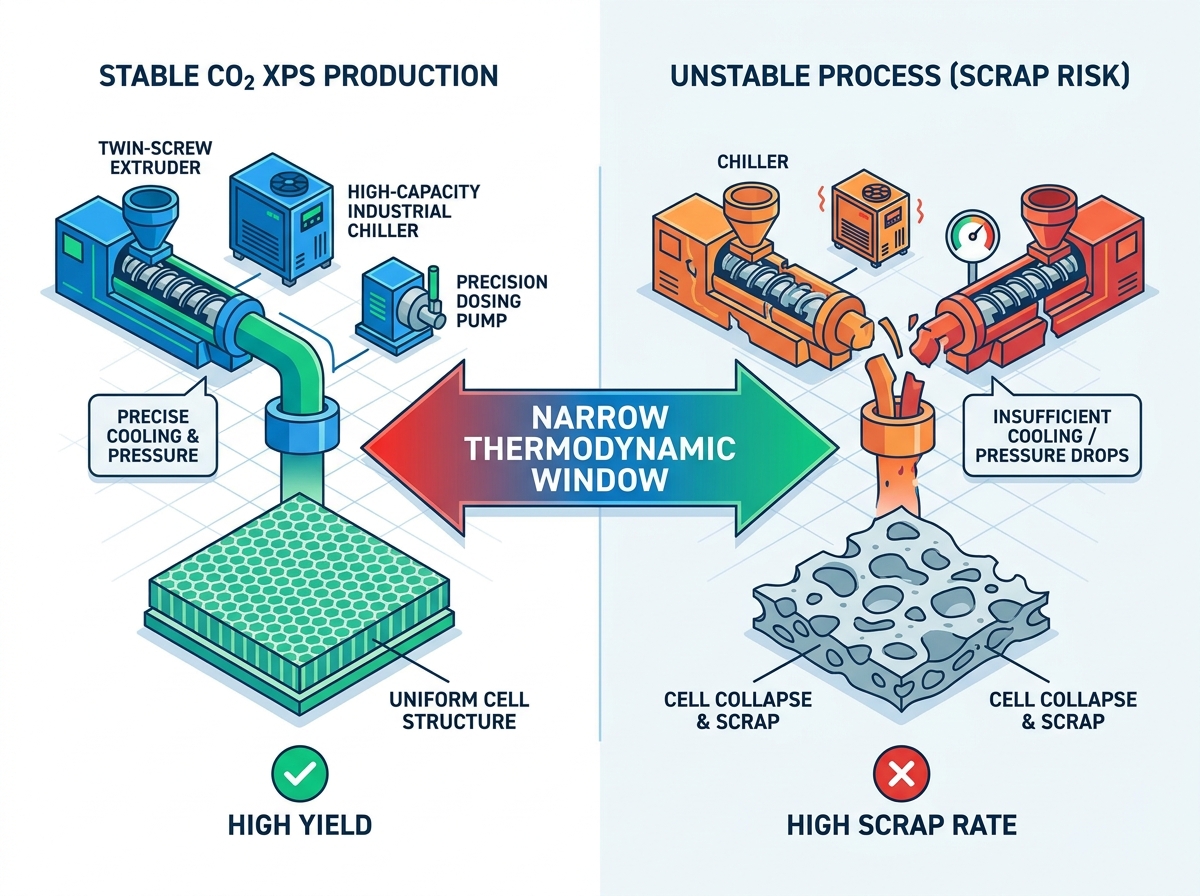
Moving to sustainable XPS foam board manufacturing requires robust high-pressure CO2 storage. Bulk tank placement dictates the safety and efficiency of your fluid delivery. You must engineer properly insulated piping for cryogenic liquid delivery. Pressure regulation systems must step down the liquid pressure precisely from the outdoor bulk tank to the indoor dosing station. Any pressure spikes will destroy the delicate mass flow meters.
Ambient environment control directly impacts profitability. Seasonal temperature swings in a manufacturing plant alter gas density. If your piping runs through a hot ceiling space in summer and a freezing warehouse in winter, the CO2 density changes constantly. Fluctuating density destroys dosing accuracy. We strongly recommend insulating all delivery lines and installing climate control around the dosing skids.
Safety and compliance demand rigorous engineering. CO2 is significantly heavier than atmospheric air. In the event of a leak, it sinks and pools in low-lying areas, trenches, or basement levels. This creates a severe asphyxiation hazard for plant personnel. You must implement the following safety protocols:
Install continuous ambient CO2 monitoring sensors at floor level.
Wire these sensors directly to automated emergency exhaust fans.
Ensure exhaust systems activate instantly around the die head.
Place additional ventilation directly beneath the primary cooling racks.
Establish visual and auditory alarm systems across the factory floor.
Achieving a premium closed cell XPS foam requires specific extrusion hardware. Primary twin-screw extruders are absolutely non-negotiable. Single-screw systems simply cannot provide the intense dispersive mixing needed to dissolve CO2 into the polystyrene melt. Twin-screw systems utilize intermeshing profiles to stretch and fold the polymer continuously. This action forces the difficult gas molecules into a homogeneous solution.
Melt conditioning relies heavily on static mixers. Dynamic cooling inside the secondary extruder barrel does much of the heavy lifting. However, dynamic cooling alone leaves minor temperature gradients in the melt flow. Static mixers correct this issue. They divide and recombine the melt flow endlessly. This creates the exact uniform melt viscosity required to trap CO2 without rupturing individual cells.
Die and calibration technology must adapt to violent gas expansion. Precision slot dies manage the rapid pressure drop precisely. If the die lip design is incorrect, the foam tears immediately upon exiting. Furthermore, calibration boards must accommodate a completely different rapid expansion profile compared to freon. You need easily adjustable, multi-zone calibration plates to tame the board profile before it hardens.
Successful execution of XPS insulation board production demands a realistic facility evaluation. Space and layout considerations dictate your daily throughput capabilities. CO2 processing requires substantially longer cooling lines. You cannot chop the boards while they remain too hot inside. Doing so causes immediate dimensional warping.
Additionally, you must account for extensive aging racks. CO2-blown boards require specific curing times. They must sit in a controlled atmospheric environment to achieve dimensional stability. The internal cell pressure must equalize with ambient air pressure. If your facility lacks the warehouse footprint to hold days of production, you will ship defective, shrinking boards to your customers.
Structural and foundation needs often surprise facility managers. Upgraded primary extruders weigh considerably more than older models. Heavy-duty industrial chillers add massive static loads to your facility floor. You must verify concrete slab thickness and structural steel limits before accepting equipment delivery.
Shortlisting logic keeps capital expenditures manageable. Audit your current plant directly against original equipment manufacturer (OEM) specifications. Determine if a targeted component retrofit is a financially viable path. Sometimes, upgrading just the dosing skid and secondary cooler works. Often, a full line replacement represents the only guaranteed path to minimizing scrap and maximizing uptime.
Profitable CO2 XPS production is not just about buying the right extruder; it is about engineering the right environment. Facility infrastructure dictates your final product quality just as much as the machinery itself. Without stable power, massive cooling capacity, and strict gas handling protocols, even the best equipment will fail to produce uniform boards.
We highly recommend conducting a comprehensive utility audit before requesting formal vendor quotes. Measure your current chilled water flow, map your floor space for expanded curing racks, and test your power grid stability. Documenting these metrics prevents costly change orders during installation.
Engage with specialized application engineers for a site feasibility assessment today. Mapping out your infrastructure gaps early ensures a seamless, profitable transition to sustainable foam production.
A: Yes, but it requires significant capital expenditure. A successful retrofit typically involves purchasing new high-pressure dosing systems. You will also need specialized screw redesigns to handle lower gas solubility. Finally, it demands massive upgrades to your existing cooling infrastructure to manage the higher thermal loads.
A: CO2 acts as a powerful plasticizer but flashes and expands aggressively. The polymer melt must be cooled to a much lower temperature prior to exiting the die. This extreme cooling gives the polymer the necessary mechanical strength to contain the expanding CO2 gas without rupturing the cell walls.
A: It varies significantly by board thickness and target density. However, CO2-blown boards generally require strict atmospheric aging protocols lasting several days to weeks. This allows safe gas exchange without shrinking or warping the final product. Therefore, adequate, climate-controlled warehouse space is absolutely mandatory.


