


Views: 0 Author: Site Editor Publish Time: 2026-11-10 Origin: Site


The 72-hour continuous trial run validates an XPS extrusion line. A successful protocol requires sustaining 100% of rated output capacity (e.g., 1000 kg/h), maintaining density variance strictly within ±1.5 kg/m³, and holding thickness tolerances below ±1.5 mm over a 72-hour period.
Commissioning an XPS extrusion line transitions the system from a mechanical assembly into a manufacturing asset. Hot commissioning culminates in the stringent 72-hour continuous run protocol. This stage proves the line's capability to process polystyrene resin, blowing agents, and additives into specification-compliant insulation boards without thermal degradation, mechanical interruption, or process instability.
The rationale behind a 72-hour duration is rooted in the thermal mass and fluid dynamics of tandem extrusion systems. Primary extruders melt the polymer and mix the supercritical gases, while secondary extruders cool the highly viscous, gas-laden melt to precise foaming temperatures. It requires 6 to 12 hours for the barrel temperatures, melt pressure at the die, and blowing agent saturation levels to achieve a thermodynamic steady state. A short 24-hour run fails to reveal creeping thermal imbalances, filter blockage rates, or secondary cooling extruder inefficiencies that appear after extended continuous load. By enforcing a 72-hour window, operators validate the robustness of the chilling systems, the endurance of the gearboxes under constant high torque, and the stability of the dynamic sealing mechanisms in the blowing agent injection pumps.
To initiate the protocol, the system must pass pre-run checks. This includes verifying that the foundation meets the stringent flatness tolerances detailed in our XPS Plant Foundation: Loads, Tolerances and Anchor Layout guide. Operators must confirm that the cooling water flow rate and temperature remain stable, ensuring the secondary extruder can dissipate the frictional heat generated during the melt cooling phase. Any deviation in foundation levelness can cause vibration harmonics to amplify over 72 hours, potentially damaging gearbox bearings. Similarly, review the mechanical assembly prerequisites and structural checks in our Step-by-Step XPS Production Line Installation Process.
If-Then Engineering Rules for Continuous Operation:
If the primary melt pressure transducer located immediately before the static mixer detects a fluctuation exceeding ±1.5 MPa over a 10-minute rolling average, then the PLC must automatically adjust the primary screw speed to compensate for the volumetric inconsistency and prevent downstream surging at the die lip.
If the main drive motor of the secondary extruder exceeds 85% of its rated continuous torque capacity for more than 5 minutes, then the thermal oil circulation rate in the barrel cooling jackets must be slightly reduced by the proportional valves to elevate the melt temperature by 1°C, lowering the polymer viscosity and relieving motor strain.
If the shutdown originates from a systemic failure within the XPS line itself, such as a die lip heater malfunction or a primary drive fault, then the clock is reset. Following the repair, the 72-hour continuous run protocol must restart from zero.
Table 1: Pre-Conditioning Parameters for 72-Hour Run
Subsystem | Parameter Monitored | Acceptable Operational Range | Monitoring Frequency |
|---|---|---|---|
Primary Extruder | Melt Pressure | 15.0 - 25.0 MPa (± 0.5 MPa) | Continuous (PLC, 100ms) |
Secondary Extruder | Melt Temperature (at Die) | 112°C - 128°C (± 0.5°C) | Continuous (PLC, 1s) |
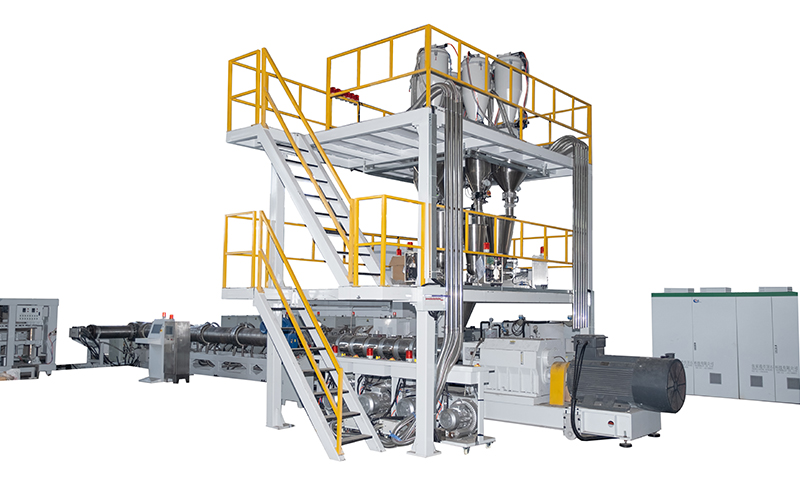
The primary metric of a successful commissioning process is the line's ability to consistently hit and maintain its rated production capacity. A line rated for 1000 kg/h must demonstrate this throughput continuously without compromising the microcellular structure of the foam. Output verification involves gravimetric blending data correlation and end-of-line board weighing. The PLC records the mass flow rate of virgin polystyrene (GPPS), recycled material, flame retardants, nucleating agents, colorants, and the physical blowing agent. This total input mass must align tightly with the weight of the finished boards and edge trim.
In high-end XPS lines, raw materials are not fed volumetrically, as variations in bulk density of the GPPS granules or regrind would lead to massive output fluctuations. Instead, continuous loss-in-weight gravimetric dosing systems are employed. These feeders sit on high-resolution load cells and communicate with the main PLC via industrial Ethernet protocols. During the 72-hour test, the accumulated mass data from the dosing system is cross-referenced with the mass of the finished boards to calculate the overall yield and identify any material losses due to out-of-spec production. Understanding the facility requirements for stable operation is vital; review the XPS Line Capacity, Footprint, Power, and Manpower specifications to ensure the plant can support these output levels and material staging requirements.
Density stability is arguably the most critical quality parameter for XPS insulation. The thermal conductivity, compressive strength, and water absorption rates are all inextricably linked to the foam's density. During the 72-hour trial, sample boards are extracted from the end of the line at predetermined intervals, typically every hour. These samples are measured and weighed to calculate their apparent density.
The acceptance criteria demand a remarkably tight density distribution. If the target density is 35.0 kg/m³, an acceptable variance is strictly ±1.5 kg/m³ across the entire 72-hour production volume. High-performance lines operating with sophisticated CO2 and ethanol blowing agent mixtures may achieve even tighter tolerances. The choice and handling of the physical blowing agent profoundly impact the density and the stability observed during the 72-hour run. Modern XPS lines predominantly utilize Carbon Dioxide (CO2) combined with co-blowing agents. Achieving a stable foam structure with CO2 requires extremely high operating pressures and intense shear mixing in the primary extruder to ensure the gas is completely dissolved into the polymer matrix. If the gas does not dissolve completely, it will form irregular voids in the final board, immediately failing the acceptance criteria.
If-Then Engineering Rules for Output and Density:
If the density drops unexpectedly below the target range, then it often points to an excessive injection of the blowing agent or an abnormally high melt temperature at the die, causing the foam to over-expand and potentially collapse. In this scenario, the operator must slightly reduce the blowing agent dosing rate by 0.5 kg/h or incrementally lower the temperature profile of the secondary cooling extruder by 0.5°C.
If the bulk density rises above the targeted 35 kg/m³ while raw material throughput remains constant, then the operator must verify the output of the CO2 injection pump; if the pump discharge pressure is observed below 150 bar, the line must be partially bypassed to inspect and replace the sintered metal micro-filters in the high-pressure gas line, as a blockage is restricting gas flow.
Table 2: Output Targets and Corresponding Injection Rates
Target Output (kg/h) | Primary Screw Speed (RPM) | Target Density (kg/m³) |
|---|---|---|
600 | 45 | 35.0 |
800 | 60 | 32.0 |
1000 | 75 | 30.0 |
While output and density dictate the material properties, dimensional accuracy dictates the board's usability in construction applications. XPS boards must fit seamlessly together, whether utilizing shiplap, tongue-and-groove, or straight edges. The 72-hour protocol involves rigorous, continuous measurement of thickness, width, length, and squareness, ensuring the thermodynamic expansion is controlled mechanically.
Thickness tolerance is the most challenging parameter to control due to the dynamic nature of the foaming process. The expansion occurs in all three dimensions as the melt exits the die, and the primary vacuum calibrator unit must constrain this expansion to form the final thickness. The expanding foam is pulled between a top and bottom plate, which are precisely spaced and actively cooled by chilled water circulation. Vacuum slots on the surface of these plates draw the skin of the foam against the metal, freezing the surface geometry while the core continues to expand and cure. During the 72-hour run, the chilled water temperature (typically 15°C to 20°C) and the flow rate must remain absolutely constant to ensure a uniform heat extraction rate.
Width and length are primarily controlled by the downstream haul-off and cross-cutting units. Width control is managed by a combination of the calibrator side-guides and the inline edge trimming saws. The extruded board is intentionally made slightly wider than the finished specification, and high-speed circular saws trim the edges to the exact width. Length and squareness are determined by the cross-cut saw, which must synchronize perfectly with the line speed via an encoder wheel. Flatness and freedom from warpage (bowing) are heavily influenced by minute variations in ambient temperature, draft, and differential cooling between the top and bottom surfaces of the board.
Beyond macroscopic dimensions, the 72-hour test strictly evaluates the surface quality. XPS boards used for thermal insulation must possess a continuous, unbroken skin to resist moisture ingress. Surface defects such as corrugation, melt fracture (often referred to as shark skin), or drag lines from the calibrator plates are heavily scrutinized and mapped.
If-Then Engineering Rules for Dimensional Tolerance:
If the thickness deviates beyond ±1.5 mm and the board is too thick, then the calibrator plates must be brought closer together via motorized jackscrews, increasing the compressive force on the expanding foam.
If the extruded board exhibits a "dog-bone" cross-sectional profile (edges significantly thicker than the center), then the operator must manually adjust the mechanical die lip bolts at the extremities to restrict local polymer flow, or alter the cooling water flow rate exclusively in the edge zones of the vacuum calibrator.
Table 3: Standard Acceptance Tolerances for XPS Boards (EN 13164 / ASTM C578)
Dimension Parameter | Target Value | Acceptable Tolerance | Measurement Method during 72h |
|---|---|---|---|
Thickness | 20 mm - 100 mm | ± 1.5 mm | Digital Caliper / Inline Scanner (hourly) |
Width | 600 mm or 1200 mm | ± 2.0 mm | Steel Ruler / Tape Measure (hourly) |
The conclusion of the 72-hour continuous run protocol transitions the project from the active commissioning phase into the formal handover and warranty period. However, the physical operation of the machinery is only one half of the acceptance criteria; the other half is the comprehensive documentation that proves the performance was achieved within specified parameters. The handover documentation package serves as the definitive baseline for future operation and maintenance, distinguishing rigorous industrial engineering from informal machine setups.
The core of this package is the 72-Hour Trial Run Log generated by the SCADA (Supervisory Control and Data Acquisition) system. This comprehensive digital record acts as an immutable ledger, detailing the hour-by-hour operational parameters, including all temperature zones, melt pressure transducers, motor loads, line speeds, and utility consumption metrics. It also incorporates the Quality Control (QC) laboratory data. The QC laboratory operates around the clock during the trial, extracting board samples at hourly intervals to test compressive strength (kPa), thermal conductivity (W/m·K), dimensional accuracy, and density. These QC reports are signed by the laboratory technician and cross-referenced with the SCADA time-stamps to correlate product quality with machine parameters perfectly.
Crucially, the documentation phase also re-verifies the safety systems under full production load. While E-stops and safety relays are tested during cold commissioning, their real-world efficacy must be proven during the 72-hour hot run. The handover documentation includes a matrix of safety interlock verifications. For example, the software logic that prevents the main extruder motors from starting if the barrel temperatures have not reached their setpoints must be documented as functional. Similarly, the over-pressure rupture discs (burst disks) installed on the extruder barrels are visually inspected post-run to ensure they exhibit no signs of stress fatigue from the prolonged continuous high-pressure operation.
If-Then Engineering Rules for Sign-Off:
If all 72 hourly QC samples fall strictly within the acceptable tolerance bands for dimension, density, and compressive strength, and the line operates continuously without any unplanned mechanical or electrical stoppage, then the equipment is deemed fully accepted, and the final handover certificate is executed unconditionally by both the supplier's chief engineer and the buyer's plant director.
If the trial run log reveals minor, non-critical deviations (such as a malfunctioning secondary HMI display panel or a brief sensor communication error that did not affect production), then a conditional sign-off is issued. This includes a binding punch-list with a strict 14-day resolution window for the supplier to rectify the issues without necessitating a repeat of the full 72-hour protocol.
The 72-hour continuous run acceptance protocol is the definitive stress test for an XPS extrusion line. It moves beyond theoretical capacity and static mechanical checks to prove the system's dynamic stability, precise thermal management, and robust mechanical endurance under sustained manufacturing pressure. By rigorously verifying output stability, tightly constrained density variance, and exact dimensional tolerances through a strict set of if-then engineering rules, manufacturers ensure they are taking possession of an asset truly capable of producing high-performance insulation boards reliably. A successful, fully documented sign-off marks the seamless transition from installation to profitable, specification-compliant, and highly efficient commercial operation.
Q: What is a 72-hour trial run? A: It is a continuous 72-hour operation test verifying thermal equilibrium, mechanical endurance, and consistent product quality under sustained full production loads.
Q: Who signs the acceptance report? A: The acceptance report is signed jointly by the equipment manufacturer's chief commissioning engineer and the buyer's authorized plant manager, verifying all contract specifications are met.
Q: What tolerance counts as pass? A: Passing tolerances typically require production output matching 100% of rated capacity, board density variations strictly below ±1.5 kg/m³, and thickness accuracy held strictly within ±1.5 mm.
Target Output (kg/h):
Grid Voltage & Transformer (V / Hz / KVA):
Ambient Temperature & Humidity (Summer/Winter °C):
Available Factory Dimensions (L x W x H):


