


Views: 0 Author: Site Editor Publish Time: 2026-11-02 Origin: Site


An XPS line running in a 20 °C factory behaves entirely differently from one running in a 45 °C desert environment. The extruder remains the same, but the thermodynamic reality of cooling the polymer shifts dramatically. When cooling circuits are undersized for high ambients, the result is not just a warm machine — it is warped boards, density drift and hard limits on production speed.
This guide details how to size cooling infrastructure for hot climates, why chillers must be derated, and how to read the thermal signature of summer board defects on a CO2 XPS production line.
Cooling is a capacity limit. An extruder can only push as much material as the downstream calibrators can successfully cool. Undersized cooling forces operators to slow the line down.
Ambient temperature derates chillers. A chiller rated for 100 tons at 30 °C ambient will deliver significantly less cooling at 45 °C. Sizing must be based on the compressor's high-ambient curve, not its nominal nameplate.
Cooling towers have a hard limit. A cooling tower cannot cool water below the ambient wet-bulb temperature. In a 50 °C environment, tower water is often too hot for gearboxes and calibrators.
Summer warping is a cooling-rate signature. Board that bows as it exits the line in summer is usually suffering from asymmetric cooling caused by calibrator water that has drifted above setpoint.
Water quality scales with evaporation. In hot climates, closed-loop systems prevent rapid mineral concentration and scaling inside the delicate cooling channels of the die and calibrator plates.
Scale improves thermal efficiency. The cooling infrastructure demand per tonne drops as line size increases from 300 kg/h up to 4,000 kg/h.
Extruding XPS board is fundamentally a process of adding heat to melt polystyrene and then removing that heat in a highly controlled sequence to freeze the cellular structure. The heat is removed by water circulating through the die, the calibrator plates, and the heat exchangers for the gearbox and hydraulic unit.
In a temperate climate, maintaining 15–25 °C cooling water is straightforward. In a 45 °C environment, the thermodynamics are hostile. The heat removed from the polymer must ultimately be rejected into the hot ambient air. Because the temperature delta (ΔT) between the cooling water and the outside air is so small, heat transfer becomes highly inefficient.
If the cooling system cannot reject heat fast enough, the loop water temperature rises. When the calibrator water rises from a target of 30 °C to an uncontrolled 38 °C, the board skin does not vitrify quickly enough. The foam continues to expand slightly after leaving the calibrator, altering the board's density and dimensions. The operator's only recourse is to slow the extruder down, sacrificing output to allow more time in the cooling section.
Calculating the cooling load begins with the mass of polymer. Cooling 1,000 kg of polystyrene from a 200 °C melt down to a stable solid requires a specific amount of energy removal per hour. To this, you must add the mechanical heat rejected by the gearbox oil coolers, the hydraulic power pack, and the barrel cooling fans.
The total heat load determines the required chiller tonnage. The flow rate of the water (liters per minute) is then determined by the maximum allowable temperature rise (ΔT) across the machine. If the calibrators require water at 25 °C and the return water cannot exceed 30 °C, the flow rate must be massive to carry the heat away with only a 5 °C rise.
This is why cooling pipes on large lines are so substantial. If the pipes are undersized, the water velocity increases, leading to pressure drops that starve the furthest calibrator zones of flow.
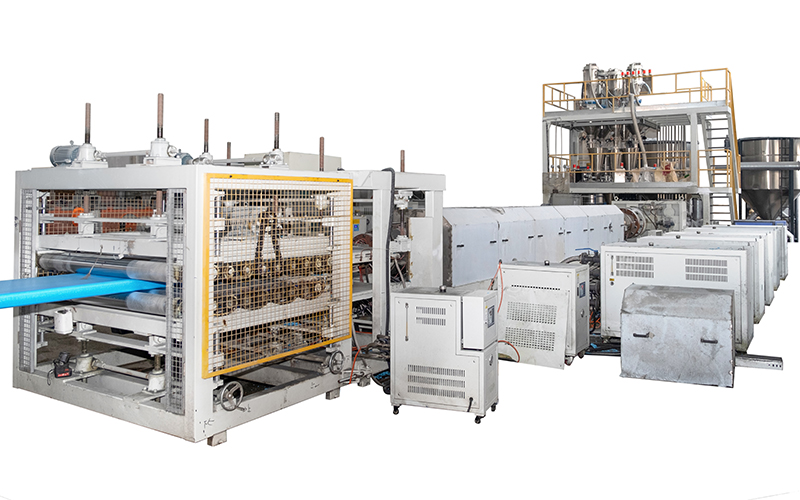
Plants have three main options for process cooling, and the choice is dictated entirely by the local climate.
Cooling Towers. Towers rely on evaporation. But physics dictates that a cooling tower can never cool water below the ambient wet-bulb temperature (a thermodynamic limit explained in energy efficiency guidelines for cooling systems). In a hot, humid environment, or a 45 °C desert, tower water will easily exceed 35 °C. While this might be sufficient to cool the barrel zones, 35 °C water is useless for chilling gearbox oil or maintaining tight dimensional control in the primary calibrators.
Mechanical Chillers. A water chiller uses a refrigerant compressor to actively cool water to precise setpoints (e.g., 15 °C), regardless of ambient temperature. It is the only way to guarantee stable board dimensions in summer. But the condenser must still reject heat into the air. If the ambient is 45 °C, the condenser struggles. You must select a chiller built for high ambients, meaning it has an oversized condenser coil and high-cfm fans.
Hybrid Systems. The most efficient setup for a large line splits the load. A cooling tower handles the high-temperature loads (barrel cooling, hydraulic heat exchangers) where 35 °C water is acceptable. A dedicated mechanical chiller handles the critical low-temperature loads (die lips, primary calibrators). This drastically reduces the required tonnage of the chiller.
The critical engineering task is derating. If a chiller catalogue states "100 Tons" at an industry-standard 30 °C ambient, that same unit might only deliver 65 Tons of cooling on a 45 °C afternoon. The sizing must be based on the compressor manufacturer's high-ambient derating curve, which MXZ provides during the layout phase.
In hot climates, evaporation rates are extreme. If an open cooling tower is used, pure water evaporates, leaving all the dissolved minerals (calcium, magnesium) behind. The concentration of these minerals rises rapidly.
When this hard water hits the hot channels of an extruder die or calibrator plate, the minerals precipitate out as scale. Scale is a phenomenal insulator. A layer of scale just 1 mm thick inside a calibrator plate will slash its heat transfer efficiency, forcing the operator to lower the water temperature further just to get the same cooling effect on the board.
For hot environments, we strongly recommend closed-loop cooling systems. The water circulating through the machine is sealed, treated, and never evaporates. It passes through a heat exchanger, which is cooled by a secondary open tower loop. The scale forms in the easily cleanable heat exchanger, not inside the inaccessible channels of the extrusion die.
When cooling infrastructure is overwhelmed, the first symptom is usually board warping that only appears during the afternoon shift.
Board that bows as it exits the line is almost always suffering from asymmetric cooling. If the cooling water is struggling to stay at setpoint, one face of the calibrator often runs slightly warmer than the other. The skin on the colder side shrinks and hardens faster than the skin on the warmer side. As the core continues to cool on the racks, this differential shrinkage bows the board.
The diagnostic step is straightforward: do not change the formulation or the die gap. Measure the water temperature entering and leaving both the top and bottom calibrator plates. If the ΔT on the top plate is larger than the bottom, the flow is unbalanced. If both are running 5 °C hotter than they did in winter, the chiller condenser is saturated.
Because ambient conditions dictate the thermodynamics, preparing a cooling package requires site-specific data. Before finalizing a layout for a hot climate, we require four parameters:
Maximum Summer Dry-Bulb and Wet-Bulb Temperatures: The absolute peak, not the annual average.
Water Source and Quality: Whether the make-up water is municipal, well water, or desalinated, which dictates the need for closed-loop heat exchangers.
Power Availability: High-ambient chillers draw significant amperage; this must be factored into the plant's total transformer sizing.
Target Output Capacity: The throughput in kg/h dictates the baseline heat rejection requirement.
In a 45 °C environment, the cooling system is not an accessory; it is the absolute limit on the line's production capacity. A massive extruder paired with an undersized chiller will never reach its rated output in summer because the calibrators simply cannot remove the heat fast enough to stabilize the board.
Designing for hot climates requires acknowledging the thermodynamics. Cooling towers cannot break the wet-bulb barrier, and mechanical chillers lose significant capacity as the ambient air heats up. The infrastructure must be oversized according to high-ambient derating curves, and the water loops must be protected from aggressive scaling through closed-loop designs.
By specifying the cooling infrastructure against the worst day of the year rather than the average, plants guarantee that their board dimensions remain stable and their output remains high, regardless of the season.
A: The flow rate depends on the line's output and the temperature delta (ΔT) allowed across the calibrators. A 1,000 kg/h line typically requires a specific tonnage of cooling capacity. Exact flow rates are calculated during the equipment layout phase based on local ambient conditions.
A: No. A cooling tower cannot cool water below the ambient wet-bulb temperature. In a 50 °C environment, tower water will often exceed 35 °C, which is too hot to properly cool the calibrators and gearboxes, leading to board warping and equipment overheating. A mechanical chiller is mandatory.
A: Summer warping is usually caused by inadequate cooling capacity resulting in higher calibrator water temperatures. If the water exceeds the setpoint, the board skin does not cool symmetrically or fast enough, creating residual thermal stresses that bow the board as it exits the line.
A: The baseline tonnage is calculated from the heat removed from the polymer plus machine losses. But if the ambient temperature is 45 °C, the nominal chiller tonnage must be significantly derated (oversized) according to the compressor manufacturer's curves to maintain the same net cooling effect.
A: While 35 °C water might be acceptable for the first cooling stage of very thick boards, it is too warm for gearboxes, hydraulic heat exchangers and the downstream calibrator zones. Supplying 35 °C water to the whole line will cause density drift and limit maximum production speed.


