


Views: 0 Author: Site Editor Publish Time: 2026-11-04 Origin: Site


Choosing the capacity of an XPS extrusion line is the most consequential decision a plant manager makes. It is not merely a question of how much board the market can absorb; it is a hard commitment to a specific building size, electrical grid connection, and labor structure. The physics of extrusion heavily reward scale, but the facility must be large enough to house it.
This guide compares small (300 kg/h) and massive (4,000 kg/h) CO2 XPS production lines, mapping how capacity dictates footprint, power demand, shift manpower and production yield.
Capacity drives the building size. A 300 kg/h line fits in a 50 × 12 × 6 m hall. A 3,000 kg/h line requires a 180 × 30 × 6 m facility to accommodate the extended downstream cooling racks safely.
Power infrastructure scales non-linearly. The electrical transformer KVA required per kilogram of output drops drastically. A large line requires less than a third of the infrastructure KVA per tonne compared to a small line.
Labor does not scale with volume. A 3,000 kg/h line requires nearly the same 3 to 4 operators per shift as a 500 kg/h line, vastly improving labor efficiency.
Yield loss hurts small lines more. Start-up scrap and continuous edge trimming consume a larger percentage of total output on small, slow lines than on fast, high-volume lines.
Continuous operation is mandatory. The start-up sequence takes approximately 35 hours. Intermittent, single-shift operation is mechanically and financially unviable regardless of line capacity.
Extrusion lines are designed to run continuously. A machine rated for 1,000 kg/h will produce roughly 24 tonnes a day, 700 tonnes a month. The first question an investor must answer is not "what can the machine do," but "can our logistics and distribution network absorb this volume every week without warehousing it indefinitely?"
If the market demand is present, the physics of extrusion overwhelmingly favor larger machines. The unit economics of producing foam board improve dramatically as the screw diameter increases. But the barrier to entry for large machines is not just capital; it is the physical infrastructure of the factory itself.
The most rigid constraint on capacity is the length of the building. Extrusion is a linear process. As capacity increases, the line speed increases. If the board is traveling faster, the downstream cooling racks, haul-off units, and automated cutting stations must be significantly longer to allow the foam's internal cellular structure to stabilize before it is cut.
Attempting to fold or compress a high-capacity line into a short building creates dangerous operator bottlenecks, insufficient cooling time, and compromised board quality.
Table 1: Reference Footprint by Extrusion Capacity
Model |
Throughput (kg/h) |
Reference Factory Layout (L × W × H) |
|---|---|---|
65-150 |
300–350 |
50 × 12 × 6 m |
75-160 |
400–450 |
60 × 12 × 6 m |
85-200 |
500–600 |
75 × 12 × 6 m |
120-300 |
900–1,500 |
120 × 20 × 6 m |
135-300 |
1,500–2,000 |
140 × 20 × 6 m |
175-500 |
3,000–4,000 |
180 × 30 × 6 m |
A plant considering a jump from 500 kg/h to 1,500 kg/h is not just buying a bigger motor; they are committing to a building that is twice as long and nearly twice as wide.
Beyond floor space, the electrical grid connection is the second hardest physical limit. Many industrial parks have strict limits on the maximum transformer KVA they will allocate to a single facility.
This is where large XPS lines demonstrate massive infrastructural efficiency. The heat lost through the barrel walls and the mechanical friction of the drives do not scale 1:1 with output.
Table 2: Transformer Requirement Scaling
Model |
Throughput |
Transformer Required |
KVA per kg/h |
|---|---|---|---|
65-150 |
~350 kg/h |
50 KVA |
0.143 |
175-500 |
~4,000 kg/h |
180 KVA |
0.045 |
The 175-500 model produces over ten times the output of the 65-150, but it requires less than four times the electrical infrastructure. If a region's power grid limits a factory to a 200 KVA transformer, deploying one large line maximizes the site's total tonnage far better than attempting to run multiple small lines.
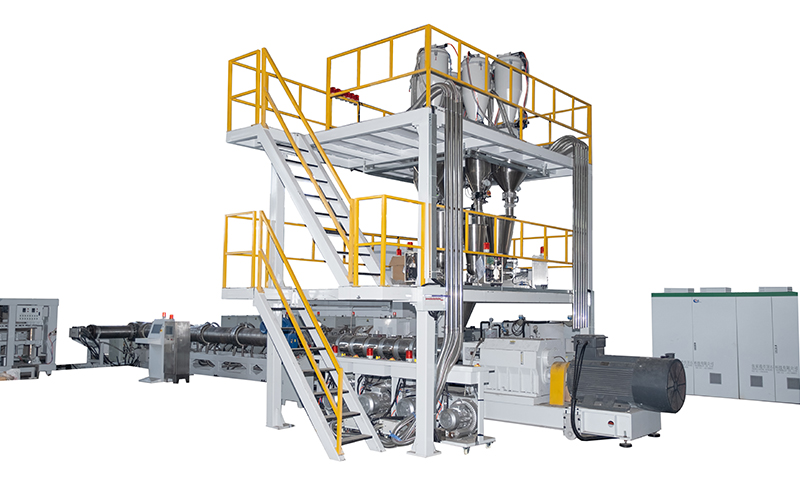
Labor efficiency in XPS extrusion is excellent because manpower does not scale linearly with production volume. The line runs continuously, and the operators monitor the process rather than physically handling the product mid-stream.
A standard shift requires:
Chief Extrusion Operator: Manages the HMI, melt temperatures, and blowing agent injection.
Downstream Technician: Monitors the calibrators, cooling racks, and board thickness tolerances.
End-of-Line Operators (1-2): Oversee the automated cutting, stacking, and packaging.
This 3-to-4 person crew is required whether the line produces 400 kg/h or 2,000 kg/h (a classic example of economies of scale in manufacturing). The primary difference on larger lines is the necessity of end-of-line automation. At 2,000 kg/h, boards are exiting the cutter too fast for manual stacking. Automated stackers and stretch-wrapping stations become mandatory, which slightly increases maintenance complexity but keeps the headcount identical to a small line.
Because MXZ equipment requires approximately 35 hours for a cold start-up and 0.51 hours for a safe shut-down, intermittent operation is unviable. Plants must staff for 24-hour continuous production, typically operating three 8-hour shifts or two 12-hour shifts.
When evaluating which capacity to choose, investors must understand how the variable inputs behave across different scales. While exact local variables apply, the relative structure is consistent globally.
Resin and Blowing Agent (Constant): The volume of raw polystyrene and CO2 scales strictly 1:1 with output. A larger line does not use less resin per board.
Yield Loss (Favors Large Lines): XPS production generates scrap. The start-up transition material (before the board reaches stable density) and the continuous edge trimming represent yield loss. On a 3,000 kg/h line, start-up scrap is a tiny fraction of a 30-day run. edge trim percentage is lower on wider boards. Incorporating a disc pulverizer to recycle clean edge trim back into the feed drastically improves overall yield across all scales.
Labor and Infrastructure (Favors Large Lines): As shown above, shift headcount and KVA infrastructure are heavily diluted across the massive volumes of a large line.
Based on global deployment patterns, most manufacturers fall into one of three capacity profiles:
1. The Regional Entrant (300–500 kg/h): Models 65-150 to 85-200. Ideal for markets with emerging insulation regulations, limited factory footprints (under 80 meters long), or regions with unstable power grids where large motor starts are problematic.
2. The National Supplier (900–1,500 kg/h): Model 120-300. The global standard for established construction material suppliers. This scale demands a dedicated 120-meter facility but hits the sweet spot between high labor efficiency and manageable capital infrastructure.
3. The Mega-Scale Exporter (2,000–4,000 kg/h): Models 135-400 and 175-500. Selected by major petrochemical groups or dominant national players. These lines require massive 160-to-180-meter facilities and heavy automation but deliver the absolute lowest unit operational inputs in the industry.
Before we finalize an equipment configuration, we require four foundational inputs from the plant planning team:
Available Factory Dimensions: Specifically the unobstructed straight-line length.
Grid Capacity: The maximum transformer KVA the local utility will authorize for the site.
Target Output Volume: The monthly tonnage the local distribution network can absorb.
Automation Preference: Whether local labor availability dictates manual or fully automated end-of-line packaging.
Choosing the right XPS capacity is an exercise in balancing market ambition against physical reality. The thermodynamics and mechanics of tandem extrusion heavily reward scale. A 3,000 kg/h line demands a fraction of the electrical KVA per tonne compared to a small line, and dilutes the shift labor overhead across massive volumes.
But scale demands space. A high-capacity line requires up to 180 meters of unobstructed factory floor to safely cool and process the board. Attempting to force high throughputs into small buildings guarantees poor board quality and safety hazards.
By mapping the available footprint and grid capacity first, investors can select the precise MXZ model that maximizes their output without over-stressing their facility's infrastructure.
A: The choice depends on your target market volume and available factory space. A 300–450 kg/h line is standard for regional startups entering the insulation market, while established manufacturers looking to supply national distribution networks typically select 1,500–3,000 kg/h models to leverage economies of scale.
A: A 900–1,500 kg/h line (such as the Model 120-300) requires a minimum reference layout of 120 x 20 x 6 meters. This footprint accommodates the primary extrusion, the extended cooling racks needed for higher speeds, the automated downstream cutters, and safe operator clearance zones.
A: A modern, automated XPS line typically requires 3 to 4 operators per shift: a chief operator at the main control panel, one technician monitoring the calibrators and cooling racks, and 1 to 2 operators handling the packaging and stacking at the end of the line. The exact number depends on the degree of end-of-line automation installed.
A: A rigorous capacity comparison must weigh the fixed capital constraints (available factory floor space and grid KVA capacity) against the scaling operational inputs: resin consumption, specific energy usage per tonne, labor distribution across shifts, and the yield loss generated during edge trimming and start-up cycles.
A: Yes. Large-scale extrusion benefits from massive economies of scale in infrastructure. The electrical transformer KVA required per kilogram of output drops significantly as line capacity increases, and a 3,000 kg/h line requires nearly the same number of shift operators as a 500 kg/h line, spreading labor overhead across a much larger volume.


