


Views: 0 Author: Site Editor Publish Time: 2026-11-03 Origin: Site


Advanced Physical Foaming: Transitioning to a PS (Polystyrene) foam wallboard production line utilizing supercritical CO2 physical foaming significantly reduces environmental impact and operational costs compared to traditional chemical methods, eliminating toxic chemical residues and unpleasant odors.
Optimized Equipment Configuration: The core of the manufacturing system relies on a specialized single-screw extruder paired with a high-pressure CO2 injection system, fundamentally replacing outdated conical twin-screw configurations previously used for processing heavy powder-based materials.
Simplified Raw Material Matrix: The modernized process exclusively uses General Purpose Polystyrene (GPPS) resin in pellet form and eliminates the need for expensive and environmentally harmful calcium-zinc or lead stabilizers, as well as CPE or ACR processing aids.
Superior Cellular Structure: The supercritical CO2 physical foaming process produces a highly uniform, closed-cell micro-cellular structure, resulting in lightweight yet structurally rigid architectural profiles with exceptional moisture resistance and thermal insulation properties.
High-Volume Output: Modern setups equipped with synchronized haul-off units and advanced vacuum calibration tables ensure high continuous output capacity and extremely precise dimensional tolerances for large-scale, automated manufacturing operations.
Streamlined Maintenance: The simplified material formulation and the complete absence of corrosive chemical foaming agents dramatically extend the operational lifespan of the extruder barrel and single screw, significantly reducing preventative maintenance downtime and operational costs.
The architectural and interior design sectors are increasingly shifting toward advanced, sustainable, and highly efficient manufacturing processes to produce lightweight decorative panels. As the demand for moisture-resistant, durable, and aesthetically pleasing wallboards grows exponentially across residential and commercial markets, manufacturers are moving away from traditional chemical foaming processes that rely on complex additive formulations. Instead, the industry standard is rapidly evolving toward the PS foam wallboard production line, driven by the significant operational and economic advantages of General Purpose Polystyrene (GPPS) and supercritical carbon dioxide (CO2) physical foaming technologies.
This technological pivot fundamentally changes how modern architectural foam wallboards are manufactured on a global scale. By replacing volatile chemical blowing agents with CO2 physical foaming, facilities can achieve a much finer, more consistent, and highly predictable closed-cell structure. This transformation not only enhances the mechanical rigidity and thermal insulation properties of the wallboards but also drastically lowers direct material costs and completely eliminates toxic chemical residues from the finished product. Consequently, the resulting PS foam boards are entirely odorless, highly eco-friendly, and perfectly suited for stringent indoor residential and commercial applications where indoor air quality is a paramount concern.
To successfully implement this transition and capitalize on these benefits, manufacturers must completely re-evaluate their existing equipment configuration. The legacy conical twin-screw extruders, which were originally designed for heavy powder processing and high-shear compounding, are no longer applicable or efficient for this modern material matrix. Instead, the updated process requires a specialized single-screw extrusion setup capable of handling solid GPPS pellets, maintaining precise and consistent melt temperatures across multiple heating zones, and seamlessly integrating with high-pressure gas injection systems. Understanding the detailed intricacies of this modern machinery, the specific raw material requirements, and the closely synchronized manufacturing process is absolutely essential for maximizing output capacity, minimizing scrap rates, and maintaining a competitive edge in the rapidly evolving modern building materials market.
Establishing a highly efficient PS foam wallboard production line requires a radical and comprehensive departure from conventional extrusion setups. Because the physical foaming process relies heavily on the precise injection and thorough dissolution of supercritical CO2 into a pressurized polymer melt, the hardware configuration must prioritize extreme pressure containment, highly precise temperature regulation, and optimal shear dynamics throughout the entire extrusion cycle. The integration of these advanced components ensures that the final architectural profiles meet the strict dimensional and structural standards demanded by contemporary builders.
At the absolute heart of the operation is the primary single-screw extruder, which serves as the foundational workhorse for the entire facility. Unlike older powder formulations which require the intense compounding and aggressive shearing action of a conical twin-screw system, GPPS resin is typically supplied in a clean, solid pellet form. A long L/D (Length to Diameter ratio) single-screw extruder is perfectly optimized for the gradual melting, conveying, and homogenizing of these clear pellets. This specialized screw is engineered with highly distinct zones for feeding, melting, and metering, ensuring a consistent, surge-free flow of the polymer melt as it travels down the heated barrel. The extended length allows for a gentle, progressive plasticization that protects the molecular integrity of the polystyrene, preventing overheating and maintaining optimal melt viscosity.
Crucially, this advanced single-screw extruder is seamlessly integrated with a state-of-the-art CO2 gas injection system. Situated strategically along the mid-section of the barrel—typically immediately after the polymer is fully melted and highly pressurized—specialized injection ports introduce supercritical carbon dioxide directly into the advancing melt stream. High-pressure metering pumps ensure that the supercritical CO2 is delivered at an absolutely constant volumetric rate, regardless of the internal barrel pressure fluctuations. The screw design in this critical injection zone features specialized, aggressive mixing elements (such as Maddock or complex pineapple mixers) designed to break the injected gas down into microscopic bubbles and dissolve it completely into the GPPS matrix. This intensive mixing creates a perfect single-phase polymer-gas solution that is primed for expansion.
Once the highly pressurized melt exits the narrow lips of the extrusion die, the sudden and dramatic pressure drop causes the dissolved CO2 to nucleate and expand rapidly. Managing this aggressive expansion is the primary role of the precision vacuum calibration table. The calibration unit utilizes heavy-duty water-cooled sizing blocks and intense, uniform vacuum suction to instantly freeze the outer skin of the expanding foam profile. This rapid quenching locks in the precise external dimensions and creates a smooth, dense, and highly rigid surface that is ideal for subsequent online lamination, hot stamping, or direct installation.
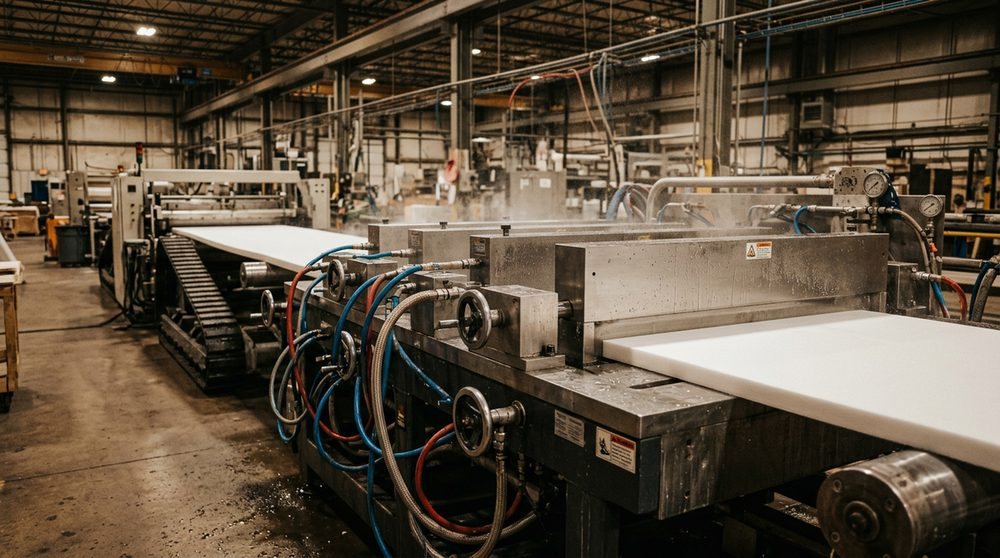
Following the vacuum calibration table, a heavy-duty, synchronized haul-off unit provides the continuous pulling force necessary to maintain proper line tension. Because the PS foam profile can be highly sensitive to stretching or buckling while still warm from the extrusion process, the haul-off speed must be meticulously and automatically synchronized with the extruder's volumetric output via closed-loop encoder feedback systems. Finally, an automated, dust-free cutting machine slices the continuous architectural profile into designated commercial lengths without interrupting the continuous flow of the line, while a pneumatic automatic stacking unit gently and safely organizes the finished boards onto pallets for final packaging and global distribution.
Component Category | Specific Equipment / Technology | Primary Function in the PS Foam Line |
|---|---|---|
Primary Extrusion | High L/D Single-Screw Extruder | Melts, conveys, and homogenizes solid GPPS pellets; builds necessary system pressure. |
Gas Injection | Supercritical CO2 Metering Pump | Injects supercritical CO2 into the polymer melt at precise, high-pressure flow rates. |
Mixing & Dissolution | Static Mixers / Specialized Screw Elements | Ensures the complete and uniform dissolution of CO2 into the polymer to form a single-phase solution. |
Shaping | Coat-Hanger Flat Extrusion Die | Distributes the hot melt evenly across the entire profile width immediately prior to expansion. |
Calibration | Vacuum Sizing and Water Cooling Table | Rapidly cools the profile, freezing the micro-cellular foam structure and ensuring strict dimensional accuracy. |
Downstream | Synchronized Haul-off and Dust-free Cutter | Pulls the rigid board at a highly stable velocity and cuts it to precise commercial lengths without halting production. |
The PS foam wallboard manufacturing process is a veritable masterclass in applied thermodynamic control and complex fluid dynamics. Unlike traditional chemical foaming, which relies passively on the thermal decomposition of solid additives to generate expanding gas, physical foaming with supercritical CO2 is a continuous, highly dynamic, and physically driven process. It demands rigorous, continuous control over temperature gradients, pressure differentials, and mechanical shear forces to produce a flawless architectural panel.
The manufacturing process officially begins as solid GPPS pellets, along with minor functional additives like nucleating agents and optional colorants, are continuously fed into the main hopper of the single-screw extruder. As the pellets travel steadily through the heated barrel, a combination of mechanical shear from the rotating screw and conductive heat from external ceramic band heaters gradually melts the resin. It is absolutely critical that the polymer is completely plasticized and free of any unmelted particles before it reaches the designated injection zone to prevent blockages or weak points.
Once the uniform melt reaches the specialized injection ports, supercritical CO2 is forcefully pumped into the barrel at pressures significantly exceeding the internal melt pressure. In this environment, the supercritical CO2 acts as a powerful temporary plasticizer, significantly reducing the overall viscosity of the GPPS melt. The specialized, high-shear mixing elements on the screw continuously fold, cut, and shear the melt, forcing the injected CO2 to dissolve completely and uniformly. This creates a homogeneous, single-phase solution of polymer and gas. Maintaining exceptionally high pressure in this specific zone is absolute paramount; any accidental pressure drop will cause premature gas expansion inside the barrel, leading to uncontrollably large voids, surface blistering, and a completely collapsed cellular structure in the final commercial product.
The critical physical transformation occurs the exact moment this single-phase solution exits the narrow lips of the flat extrusion die. The sudden and massive thermodynamic drop from the extreme high pressure inside the die to standard atmospheric pressure causes profound thermodynamic instability. The dissolved supercritical CO2 instantly comes out of solution, generating billions of microscopic bubbles simultaneously—a process technically known as nucleation. The nucleating agents (typically ultra-fine talc powder) that were added during the initial feeding stage act as essential seeding sites, ensuring that the resulting bubbles are perfectly uniform, densely packed, and microscopic in size.
As these billions of bubbles grow simultaneously, the PS matrix expands rapidly to form the thick profile of the board. However, this aggressive expansion must be immediately and precisely controlled to prevent structural deformation. The expanding melt is drawn directly into the heavy-duty vacuum calibration table. The chilled water running continuously through the precision-machined sizing plates instantly cools the outer layer of the hot profile, freezing the polymer chains in place and creating a highly rigid, dense outer skin. This tough skin acts as a barrier that prevents the internal gases from escaping to the atmosphere and forces all remaining expansion to occur strictly inward, yielding a highly uniform, structurally sound, closed-cell micro-cellular core.
Because the underlying principles of extrusion and physical foaming are highly adaptable, this specific manufacturing process is fundamentally similar to other advanced profile extrusion systems in the industry. For example, the core machinery configurations and thermodynamic principles utilized here closely mirror the PS foam wallboard production line technology frequently applied to the production of XPS ceiling profiles and similar PS foaming profile routes. Both operational systems rely heavily on robust single-screw melting dynamics, high-pressure physical gas injection, and extremely precise pressure management to achieve their exceptional, lightweight product characteristics. Note that this referenced route represents a similar PS foaming profile route rather than the exact wallboard configuration.
One of the most compelling financial, environmental, and operational advantages of transitioning to a PS foam wallboard production line is the drastic and highly beneficial simplification of the raw material matrix. Legacy chemical foaming systems demand a highly complex, expensive, and sensitive recipe of resins, hazardous chemical blowing agents, heavy metal thermal stabilizers (such as toxic lead or expensive calcium-zinc complexes), and costly polymeric processing aids (such as CPE or ACR) just to ensure the material survives the harsh extrusion process without degrading. The modern PS physical foaming process completely eliminates almost all of this operational complexity and hazard.
The foundational and primary material for this advanced process is General Purpose Polystyrene (GPPS). Supplied globally in clear, rigid, and inexpensive pellets, GPPS boasts excellent inherent melt stability, extremely high tensile strength, and superior long-term dimensional stability. Unlike older materials, which are highly sensitive to thermal degradation and require extensive chemical stabilization to prevent burning, GPPS can effortlessly withstand the high temperatures required for single-screw extrusion without breaking down or releasing corrosive, equipment-damaging gasses. This inherent thermal stability completely eliminates the expensive need for thermal stabilizers, simplifying inventory and reducing costs.
Furthermore, GPPS exhibits exceptional rheological properties when intentionally combined with supercritical CO2. The carbon dioxide dissolves readily and uniformly into the polystyrene matrix, effectively acting as a temporary, highly efficient plasticizer that significantly lowers the melt viscosity. This unique interaction allows the heavy-duty extruder to operate at much lower temperatures than would otherwise be required, saving massive amounts of electrical energy while simultaneously ensuring a highly homogeneous, smooth melt flow that is easy to shape and control.
While the primary formulation is remarkably simple, achieving a high-quality micro-cellular structure requires the precise addition of a specific functional additive: a nucleating agent. Ultra-fine talc powder is the globally recognized industry standard for this critical application. During the sudden and dramatic pressure drop at the die exit, the microscopic talc particles provide the massive physical surface area necessary for the escaping CO2 gas to form billions of bubbles simultaneously. Without sufficient talc nucleation, the expanding CO2 would simply form a small number of large, irregular, and structurally weak bubbles, resulting in a brittle board with an uneven, unsellable surface. By carefully and precisely controlling the talc concentration in the hopper, manufacturers can deliberately dictate the internal cell density and average bubble size, directly engineering the mechanical rigidity and weight of the final wallboard.
Additionally, depending on the final commercial application of the wallboard, manufacturers may occasionally incorporate specialized color masterbatches for base tinting, or specific halogen-free flame retardants to meet stringent commercial building codes. However, it is absolutely crucial to ensure that any functional additive used can comfortably withstand the extreme high-pressure environment of the CO2 injection zone without agglomerating, degrading, or interfering with the delicate gas dissolution process. The complete and total absence of traditional chemical foaming agents ensures that the final architectural product contains absolutely no toxic chemical residues, making it exceptionally safe for sensitive interior environments and significantly easier to recycle at the end of its long operational lifespan.
Evaluating the long-term commercial viability and profitability of a PS foam wallboard production line hinges critically on deeply understanding its output capacity and the various operational factors that dictate maximum line speed. Profitability in the highly competitive architectural profile manufacturing sector is directly and inextricably tied to continuous, high-volume throughput combined with absolutely minimal scrap and rejection rates. The strategic shift to a single-screw, CO2-injected system offers distinct, measurable advantages in scaling production compared to traditional, outdated methods.
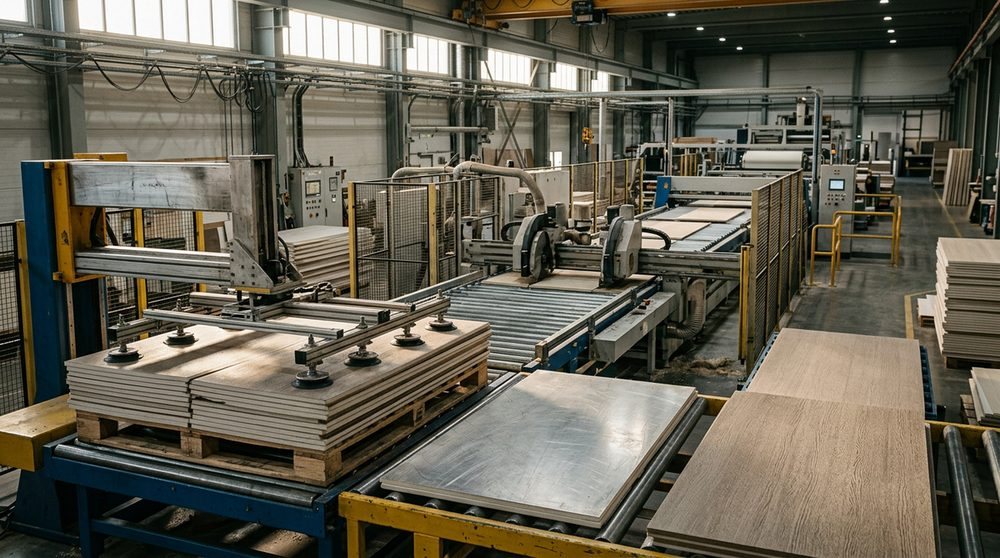
The primary physical constraint on total output capacity is the physical size, motor power, and L/D ratio of the single-screw extruder, coupled tightly with the volumetric efficiency of the high-pressure CO2 injection pump. Because GPPS saturated with dissolved CO2 inherently possesses a significantly lower melt viscosity, a well-designed, robust single-screw extruder can continuously process material at significantly higher speeds than a comparable conical twin-screw processing highly viscous, rigid powder compounds.
Modern, high-performance manufacturing lines typically feature main extruders with large screw diameters ranging broadly from 90mm up to 150mm, with L/D ratios of 33:1 or even higher to guarantee sufficient residence time for perfect gas dissolution. A standard, industry-workhorse 120mm single-screw setup can comfortably and reliably achieve continuous throughputs of 350 to 500 kilograms per hour, depending heavily on the targeted final board density, the specific cross-sectional dimensions, and the efficiency of the cooling infrastructure.
While the primary extruder fundamentally determines how much hot melt is produced per hour, the actual linear line speed—how fast the finished, rigid board physically moves down the factory track—is strictly governed by the thermodynamic cooling capacity of the vacuum calibration table. Physical foaming utilizing supercritical CO2 results in an inherently endothermic expansion process; as the highly pressurized gas expands into bubbles, it absorbs heat, cooling the surrounding melt slightly. This provides a minor but helpful thermodynamic advantage over chemical foaming, which is frequently an exothermic reaction that generates unwanted excess heat.
However, despite this slight endothermic cooling, the massive wallboard must still be rapidly and aggressively cooled from its high extrusion temperature (often hovering around 180°C to 200°C) down to a highly stable, rigid handling temperature below 50°C before it physically reaches the heavy rubber caterpillars of the haul-off unit. If the operator sets the line speed to exceed the total cooling capacity of the water system, the inner core of the thick board will remain soft and semi-molten. When grasped tightly by the mechanical haul-off caterpillars, a soft core will instantly crush, permanently warping the board, ruining the strict dimensional tolerances, and resulting in immediate scrap. Therefore, maximizing overall output capacity requires significant upfront investment in extended, high-efficiency vacuum cooling tanks paired with high-flow, closed-loop industrial chilling systems.
Extruder Model (Screw Diameter) | Main Motor Power (kW) | Max Output Capacity (kg/h) | Typical Line Speed (m/min) | Target Board Width (mm) |
|---|---|---|---|---|
SJ-90/33 | 75 - 90 | 150 - 250 | 2.0 - 4.5 | 300 - 600 |
SJ-100/33 | 110 - 132 | 250 - 350 | 3.0 - 5.5 | 400 - 800 |
SJ-120/33 | 132 - 160 | 350 - 500 | 4.0 - 7.0 | 600 - 1200 |
SJ-150/33 | 200 - 250 | 500 - 750 | 5.0 - 8.5 | 800 - 1220 |
Maintaining a highly advanced PS foam wallboard production line presents a significantly different and generally more streamlined set of protocols compared to managing legacy, powder-based systems. The fundamental shift in raw materials and foaming technologies drastically reduces certain types of aggressive mechanical wear while simultaneously introducing new, highly specialized areas requiring dedicated technical support and monitoring. Implementing a rigorous, uncompromising preventative maintenance schedule is absolutely essential for ensuring maximum facility uptime and consistently preserving the tight dimensional tolerances required for premium, retail-ready architectural profiles.
One of the most immediate, highly profitable benefits of entirely eliminating complex powder formulations and highly corrosive chemical blowing agents is the drastically extended operational lifespan of the core extrusion components. Older processing methods frequently released highly corrosive byproducts under extreme heat, which chemically degraded standard steel barrels, necessitating the use of expensive high-alloy materials and requiring frequent, costly replacements. Furthermore, the complete absence of highly abrasive mineral fillers dramatically reduces the physical mechanical wear on the delicate screw flights over time.
Because pure GPPS is entirely non-corrosive and generally far less abrasive than heavily filled compounds, the single-screw and the surrounding barrel experience significantly less physical and chemical degradation. Routine, day-to-day maintenance in this specific area focuses primarily on closely monitoring the heavy-duty gear reducer oil levels, inspecting the massive thrust bearings for any signs of premature wear, and ensuring that all external ceramic heating bands and internal thermocouples are functioning accurately and efficiently. Maintaining absolutely precise temperature control is critical; a single failed heater band can drastically alter the melt viscosity in a specific zone, immediately disrupting the delicate CO2 dissolution process and ruining the product.
The supercritical CO2 injection system is undeniably the most technically sensitive and demanding component of the entire manufacturing line and requires dedicated, highly trained technical support. The extreme high-pressure metering pumps must operate flawlessly twenty-four hours a day to ensure a continuous, completely unvarying flow of supercritical fluid directly into the highly pressurized barrel. Critical maintenance protocols for this advanced system include:
Seal Inspection: The heavy-duty high-pressure seals on the injection valves and precision metering pumps must be inspected regularly and meticulously. Any microscopic leak in these seals will instantly cause fluctuations in injected gas pressure, leading directly to uneven foaming, large internal voids, and severe density variations in the final architectural board.
Filter Replacement: The main CO2 supply lines must be equipped with industrial-grade, micron-level filters to prevent any microscopic particulate matter from entering the sensitive high-pressure pump or irreversibly clogging the tiny injection ports located on the side of the extruder barrel.
Calibration: The advanced mass flow meters responsible for controlling the exact CO2 injection rate must be recalibrated periodically by certified technicians to ensure the precise, optimal ratio of expanding gas to polymer melt is maintained at all times.
Finally, the vacuum calibration table demands rigorous, daily attention from operators. The highly intricate water cooling channels and narrow vacuum slots machined into the heavy sizing plates can gradually accumulate microscopic polymer dust or hard mineral deposits from the facility's cooling water supply. Operators must systematically and thoroughly clean these plates and aggressively back-flush the water lines to maintain maximum heat transfer efficiency and strong vacuum grip. Failure to adhere to this cleaning schedule will rapidly result in severe surface scoring, inconsistent cooling, and severely warped profiles, directly and negatively impacting the overall financial yield of your PS foam wallboard production line.
The strategic transition to a PS foam wallboard production line utilizing advanced supercritical CO2 physical foaming represents a massive, highly profitable leap forward in manufacturing technology for the global building materials sector. By definitively abandoning the highly complex, chemically intense, and often highly corrosive legacy processes of the past, modern manufacturers can achieve unprecedented, industry-leading levels of operational efficiency, significant cost reduction, and superior product quality. The seamless integration of specialized, high-capacity single-screw extruders with state-of-the-art, high-pressure gas injection systems allows for the continuous, automated creation of exceptionally lightweight, structurally rigid, and completely eco-friendly architectural profiles.
However, fully realizing these massive financial and operational benefits requires a deep, comprehensive understanding of the specific equipment configuration, rigorous and uncompromising control over the simplified raw material matrix, and meticulous, scheduled maintenance of the highly sensitive high-pressure injection systems. By purposefully investing in robust, high-quality machinery, prioritizing massive precision cooling infrastructure, and adhering strictly to established operational protocols, forward-thinking manufacturers can drastically maximize their continuous output capacity and secure a highly dominant, profitable position in the rapidly expanding global market for sustainable, premium interior wallboards.
A: General Purpose Polystyrene (GPPS) possesses excellent inherent melt strength and superb thermal stability, allowing it to be processed continuously at high temperatures without chemically degrading or burning. More importantly, GPPS has a uniquely high solubility for supercritical CO2. The injected CO2 acts as a powerful temporary plasticizer, creating a highly homogeneous, exceptionally low-viscosity melt that expands uniformly and predictably upon exiting the die, producing a superior, rigid closed-cell structure that is exceptionally difficult to achieve with other rigid materials.
A: It entirely eliminates the need for hazardous chemical blowing agents (which must decompose thermally to create expanding gas) and complex, expensive heavy-metal thermal stabilizers. However, the advanced process still strictly requires minor functional additives, specifically high-quality nucleating agents like ultra-fine talc powder. These nucleating agents provide the essential microscopic physical sites where the dissolved CO2 can rapidly form billions of tiny bubbles as the pressure drops, ensuring a fine, dense, and structurally sound cellular structure.
A: The injection system utilizes highly specialized, industrial-grade high-pressure metering pumps (often robust diaphragm or heavy-duty plunger pumps) capable of generating injection pressures significantly higher than the extreme internal pressure of the extruder barrel itself. These precision pumps are continuously controlled by advanced electronic mass flow meters and closed-loop feedback systems, ensuring that the supercritical CO2 is injected at an absolutely constant, highly precise volumetric rate regardless of any minor fluctuations in the extruder's internal resistance.
A: Dimensional warping is almost always caused by a fundamental mismatch between the aggressive line speed and the total thermodynamic cooling capacity of the vacuum calibration table. If the thick board is pulled through the chilled cooling tank too quickly, the inner core remains dangerously hot and soft. When the board is subsequently handled by the mechanical haul-off unit or automatically stacked, the uneven cooling profile and soft core cause the profile to shrink unevenly over time, resulting in permanent warping and total loss of dimensional tolerance.
A: Generally, no, they cannot. Conical twin-screw extruders are engineered specifically for the highly aggressive, high-shear compounding of heavy powder formulations. The physical foaming of solid GPPS pellets fundamentally requires a long L/D single-screw extruder designed with highly specific melting, conveying, and intensive mixing zones optimized for complete gas dissolution. The internal geometry, shear dynamics, and pressure profiles of a legacy twin-screw system are fundamentally incompatible with the precise, high-pressure injection and single-phase dissolution required for high-quality supercritical CO2 foaming.


