


Views: 0 Author: Site Editor Publish Time: 2026-10-15 Origin: Site


Installing PS foam underlayment correctly is vital for acoustic performance and structural integrity of modern floors. As a foundational layer, it compensates for minor imperfections, provides dampening, and delivers moisture protection. These benefits require selecting the appropriate thickness and density, along with flawless installation techniques. This guide helps contractors and buyers navigate installation, subfloor preparation, and material specifications. We will also compare installation scenarios, outline common mistakes, and explain production using Mingxinzhi (MXZ) equipment.

Prepare the Subfloor Properly: Subfloors must be clean, dry, and flat within a 3mm variance.
Match Thickness to the Application: A 2mm thickness suits residential uses; commercial spaces require more.
Use High Density for Compression Resistance: High-density PS foam underlayment resists heavy loads effectively.
Implement Strict Moisture Management: When installing over concrete, using a vapor barrier is mandatory.
Leave Perimeter Expansion Gaps: Maintaining an 8-10mm expansion gap at walls allows flooring to expand.
Rely on Precision Extrusion Equipment: High-performance underlayment is manufactured using extrusion lines from MXZ.
Polystyrene (PS) foam underlayment is a synthetic material placed beneath hard floorings like laminate and vinyl. Extruded into a closed-cell structure, it offers exceptional compressive strength, thermal insulation, and moisture resistance. Its closed-cell matrix prevents water absorption, ensuring reliability in damp environments.
It acts as a shock absorber, reducing ambient noise and sound transmission to floors below. Additionally, it levels minor subfloor irregularities that could otherwise stress interlocking joints on the finished floor.
In residential settings, it is often installed over concrete slabs for a thermal break. In commercial installations, higher density variants withstand heavy foot traffic and rolling loads, ensuring floor durability and comfort from condominiums to retail showrooms.
Choosing the correct thickness and density for PS foam underlayment is a critical decision that impacts the lifespan of the flooring installation. These parameters dictate acoustic insulation, load performance, and the capacity to smooth imperfections. A mismatch between underlayment specifications and flooring type can lead to broken locking mechanisms.
Table 1: Thickness and Density Guidelines
Specification |
Standard Residential Application |
Heavy Commercial Application |
Acoustic Focus Application |
Underfloor Heating Compatibility |
|---|---|---|---|---|
Recommended Thickness |
1.5mm to 2.0mm |
1.0mm to 1.5mm |
3.0mm to 5.0mm |
1.5mm to 2.0mm |
Recommended Density |
30 kg/m³ to 50 kg/m³ |
80 kg/m³ to 120 kg/m³ |
40 kg/m³ to 60 kg/m³ |
High density, specialized formulation |
Compressive Strength |
> 90 kPa |
> 400 kPa |
> 100 kPa |
> 200 kPa |
Primary Benefit |
Comfort and basic leveling |
Extreme load resistance |
Maximum sound reduction |
Thermal conductivity |
Note: Table 1 lists commonly quoted industry guidance ranges for underlayment selection. Exact values vary by manufacturer, formulation and the applicable test standard, and are not a specification of any MXZ product.
Thickness heavily influences comfort and acoustics. Thicker underlayments (3mm-5mm) provide a substantial cushion, absorbing footsteps' kinetic energy for a softer feel.
A thicker PS foam layer excels at decoupling the hard surface from the subfloor, interrupting impact noises. However, excessive thickness causes over-deflection under load. This excessive movement stresses floating floor joints, potentially causing separation.
While thickness provides cushioning, density determines compressive strength—the ability to resist permanent flattening from heavy weights or impacts. High-density underlayment is essential in high-traffic commercial spaces.
Low-density foams may bottom out under pressure, causing the flooring to lose support, leading to squeaking and joint failure. High-density PS foam maintains dimensional stability, distributing loads to safeguard interlocking mechanisms. This is especially critical for LVT or SPC flooring to prevent indentations.
Flooring success depends heavily on subfloor preparation. Even the best PS foam cannot compensate for a severely undulating, compromised, or moisture-saturated subfloor, making a rigorous preparation protocol essential.
Industry standards dictate subfloors must not deviate more than 3mm over a 2m span. While PS foam bridges minor imperfections, it cannot substitute for a level base.
Evaluate flatness using a straightedge across the room. High spots must be ground or sanded down, while low depressions must be filled with a self-leveling compound. Failing to achieve a flat subfloor creates a trampoline effect, causing the finished floor to bounce and destroy locking joints.
Moisture management is a critical aspect of installing flooring over a concrete subfloor. Concrete is inherently porous and continuously emits water vapor as it interacts with ground moisture. If this moisture is trapped beneath the flooring, it will cause wood-based products to warp and delaminate, and foster the rapid growth of mold.
Rigorous moisture testing is mandatory before installation. If levels exceed limits, mitigation strategies are required. Many premium PS foam underlayments feature an integrated vapor barrier film, which must face downward toward the concrete. If lacking an integrated barrier, a separate 6-mil polyethylene moisture barrier must be laid down first, with extensive overlapping and taping at all seams to seal against rising damp.
The final subfloor preparation involves meticulous cleaning. The subfloor must be free of dust, debris, and adhesive residue, as debris can telegraph through thin floorings or create a crunching sound. Thorough sweeping and vacuuming are required.
Equally important is acclimating both the PS foam and finished flooring. Materials must sit in the installation environment for 48 to 72 hours before installation. The HVAC system must maintain the intended room temperature and humidity, allowing materials to reach equilibrium and reducing the risk of post-installation buckling.
With a meticulously prepared, flat, dry, and clean subfloor, the actual installation of the PS foam underlayment can commence. This process requires precision, attention to detail, and a strict adherence to best practices to ensure the underlayment performs optimally.
Unroll the PS foam along the room's longest wall, parallel to the flooring planks. Allow the material to relax completely flat and lose its coiled memory.
Cut the underlayment with a sharp utility knife and straightedge for clean cuts. Carefully cut around fixed obstacles like radiator pipes and door casings. The underlayment should fit snugly around these elements without bunching or leaving gaps, ensuring the finished floor is properly supported and insulated.
Managing seams is critical to maintaining a continuous vapor barrier. Most PS foam rolls are laid side-by-side without overlapping the foam, as overlap creates a ridge that compromises floor flatness.
Rows should tightly abut without buckling. If the underlayment features a pre-attached vapor barrier with an overlapping flap and adhesive strip, peel the liner and press the flap firmly over the adjacent row. If lacking an integrated adhesive, every seam must be meticulously sealed with moisture-resistant tape, pressed firmly along the entire seam for absolute moisture control.
One of the most frequently overlooked, yet essential, steps in installation is the provision of adequate expansion gaps. All flooring materials expand and contract in response to microscopic fluctuations in temperature and ambient humidity.
When installing the PS foam underlayment, it should generally be run up the perimeter walls slightly—typically by about an inch—to create a continuous moisture envelope. However, when the actual hard surface flooring is installed over the underlayment, a strict expansion gap must be maintained between the edge of the flooring planks and the structural walls. This gap is typically specified at 8 to 10 millimeters. Spacers should be used uniformly around the perimeter of the room to enforce this gap. If this critical space is omitted, the expanding floor will press against the immovable walls, resulting in severe buckling and irreversible damage.
The installation methodology for PS foam underlayment must adapt significantly based on the specific demands of the environment and the overarching flooring system. What works perfectly in a standard residential floating floor may fail in a commercial setting or over radiant heating systems.
Table 2: Installation Scenarios Comparison
Scenario |
Primary Requirement |
Underlayment Specification |
Key Installation Focus |
|---|---|---|---|
Floating Floors (Residential) |
Acoustic dampening, minor leveling |
Medium density (30-50 kg/m³), 2mm thick |
Proper seam taping, vapor barrier over concrete |
Underfloor Heating Systems |
High thermal conductivity |
Specialized high-density foam, low thermal resistance |
Ensuring no air pockets act as insulation |
Commercial Environments |
Extreme compressive strength |
Ultra-high density (>80 kg/m³), lower thickness (1-1.5mm) |
Flawless subfloor flatness to prevent joint failure under rolling loads |
When installing over underfloor radiant heating systems, standard insulation rules are inverted. Here, the underlayment must allow thermal energy to pass efficiently into the room rather than blocking it. A specialized, low-thermal-resistance PS foam is required to prevent the underlayment from trapping heat. In commercial environments, the focus shifts entirely to compressive strength. The underlayment must be extremely dense and relatively thin to prevent any vertical movement under heavy rolling loads, which would quickly destroy the joints of commercial laminate.
Even experienced flooring contractors can fall prey to subtle installation errors that severely compromise the performance of the flooring system. Identifying and avoiding these pitfalls is crucial for a successful installation.
Table 3: Common Installation Mistakes
Error |
Consequence |
Prevention |
|---|---|---|
Failing to level the subfloor |
Bouncing floors, joint separation, squeaking noises |
Meticulously test flatness and use self-leveling compound or grinding as required. |
Ignoring moisture testing |
Warped planks, mold growth, cupping of wood floors |
Always test concrete subfloors for moisture emissions; use an integrated vapor barrier. |
Overlapping foam seams |
Ridges visible through the floor, uneven surface |
Abut foam seams tightly without overlapping; only overlap the extended vapor barrier film. |
Omitting perimeter expansion gaps |
Floor buckling, peaking at the center of the room |
Use uniform spacers to maintain an 8-10mm gap between the flooring edge and all walls. |
Using incorrect sealing tape |
Tape degrades, allowing moisture to breach the barrier |
Exclusively use manufacturer-recommended moisture-resistant sealing tape. |
Understanding the manufacturing process of PS foam underlayment provides critical insight into why it performs exceptionally well in the field. The quality, density, and consistency of the foam are directly determined by the extrusion equipment utilized during production. Mingxinzhi (MXZ) engineers cutting-edge machinery designed to produce premium underlayment with precision.
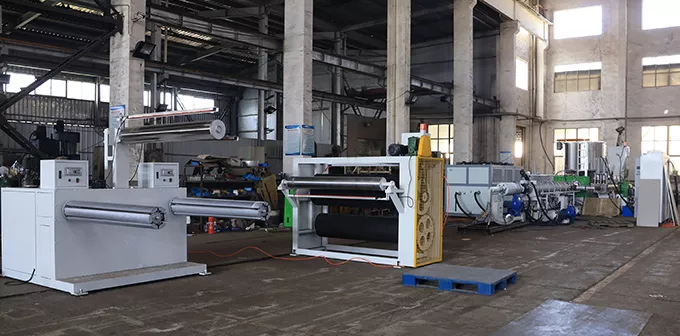
The manufacturing journey begins in a high-capacity PS foam underlayment production line. Raw polystyrene resin pellets are introduced into the extruder, where they are melted under intense heat and pressure. A precisely calibrated blowing agent is then injected. As the mixture is forced through a specialized die, the sudden drop in pressure causes the blowing agent to expand rapidly, creating millions of microscopic, closed-cell bubbles.
MXZ equipment is renowned for its robust production capabilities and efficiency. For example, the MXZ Model 65-150 produces 300–350 kg/h while requiring an installed power of 280 KVA. For larger-scale manufacturing operations, the more powerful Model 75-150 produces 400–500 kg/h, requiring 320 KVA of power. These complete manufacturing setups require a substantial operational footprint, specifically 50x12x6m, to accommodate the extensive cooling, pulling, and winding machinery.
Once the primary foam sheet is extruded, it may undergo further processing. To improve flexibility and eliminate residual stress within the foam structure, the material is often processed through a secondary foaming dedicated oven. If the underlayment requires an integrated vapor barrier, it is passed through a laminating machine, where a high-density polyethylene film is bonded to the foam surface. For specialized applications, the material might be further refined using a PS foam floor covering production line to create different surface textures or composite structures. Finally, to facilitate easier transportation and handling on the job site, the underlayment is often processed through a folding machine, allowing it to be packaged into compact blocks.
The successful installation of modern flooring systems relies heavily on the quality and correct specification of the foundational layers. PS foam underlayment serves as a critical interface, providing acoustic dampening, structural support, and vital protection against latent moisture. By carefully selecting the appropriate thickness and density for the specific application—whether for residential comfort, commercial durability, or radiant heating compatibility—project managers and contractors can ensure a high-performance floor.
Equally important is the rigorous adherence to proper installation protocols. Meticulous subfloor preparation, precise moisture management, and the disciplined execution of layout, taping, and expansion gap requirements are non-negotiable steps. Overlooking these details can rapidly lead to catastrophic flooring failures, resulting in costly callbacks and compromised structural integrity. Treating the underlayment installation with precision guarantees a flawless outcome.
Ultimately, the exceptional performance characteristics of high-quality underlayment are directly derived from the advanced extrusion technology used in its manufacture. Mingxinzhi stands at the forefront of this industrial capability, providing the heavy-duty machinery required to produce superior foam products at scale. To learn more about the advanced equipment that makes these high-performance flooring solutions possible, and to explore how MXZ can elevate your manufacturing capabilities, discover the robust engineering behind the PS foam underlayment production line.
A: Yes, PS foam underlayment is recommended for concrete subfloors due to its moisture resistance. Because concrete emits water vapor, it is essential to use a PS foam product with an integrated vapor barrier, or to install a separate 6-mil polyethylene moisture barrier beneath the foam. All seams must be taped to prevent moisture from reaching the flooring.
A: This depends on the specific PS foam product you select and the subfloor type. If you are installing over a concrete subfloor, a moisture barrier is mandatory. Many premium PS foam underlayments come with a pre-attached vapor barrier film, eliminating the need for a separate layer. If your underlayment lacks this, you must lay down a separate moisture barrier first.
A: While the underlayment can be run slightly up the wall to create a moisture seal, the hard surface flooring requires a strict expansion gap. Industry standard dictates an expansion gap of 8 to 10 millimeters around the entire perimeter of the room, as well as around fixed obstacles. Always refer to the flooring manufacturer's guidelines.
A: Yes, but you must select a specific type of PS foam underlayment engineered for this application. Standard underlayments act as thermal insulators, which block heat from radiating into the room. You must choose a high-density, low-thermal-resistance underlayment designed specifically for radiant heating systems.
A: It is critical to use a high-quality, moisture-resistant sealing tape recommended by the manufacturer. Do not use standard duct tape or masking tape, as their adhesives degrade over time, causing seams to open and allowing moisture to breach the barrier. Specialized tapes maintain a permanent seal over the lifespan of the installation.


