


Views: 0 Author: Site Editor Publish Time: 2026-08-24 Origin: Site


For manufacturers scaling insulation board production, underestimating equipment configuration presents serious financial risks. Poor machinery choices quickly lead to operational bottlenecks and excessive scrap rates. Future environmental compliance issues also threaten poorly planned facilities. A complete setup goes far beyond a single standalone machine. It relies on a highly synchronized system of raw material handling. The process integrates primary and secondary extrusion alongside precise gas injection. Furthermore, downstream calibration plays a major role in dimensional success. Missing critical auxiliary components disrupts your return on investment entirely. Opting for outdated foaming technology severely limits production capabilities and market reach. This guide deconstructs the exact equipment required today. We explore everything needed for a modern, compliance-ready setup. Plant managers and purchasing directors will gain a highly transparent evaluation framework here. You can use this technical knowledge to assess vendor quotes accurately and make confident engineering decisions.
A high-yield XPS extrusion line relies on a tandem extruder setup (primary for melting/mixing, secondary for cooling) to achieve the required cell structure.
Transitioning to eco-friendly CO2 foaming agents requires specialized high-pressure injection systems and optimized static mixers.
Downstream equipment—including calibration units, haul-offs, and surface millers—dictates final board dimensional stability and market readiness.
Integrating inline edge-trim recycling is not optional; it is a critical requirement for maintaining competitive OPEX margins.
The primary extruder handles the initial melting and mixing phases. This stage demands exceptionally high shear forces. It also requires precise temperature control across multiple heating zones. Industry experts strongly recommend twin-screw configurations for this primary stage. Twin-screw designs ensure optimal dispersion of the raw polystyrene resin. They also mix nucleating agents and flame retardants thoroughly into the polymer matrix. Proper dispersion prevents clumps and guarantees uniform structural integrity. Without this homogenization, the final insulation board will suffer from inconsistent thermal resistance.
Following the primary stage, the melt transfers into the secondary extruder. This step proves why a tandem XPS extruder system remains non-negotiable for high-quality production. The secondary machine operates as a single-screw extruder. Its main function involves gently cooling the polymer melt. It must lower the temperature while maintaining extremely high internal pressure. This high pressure prevents the blowing agent from expanding prematurely. Premature foaming ruins the internal cellular structure entirely. Dedicated cooling ensures the melt reaches the exact viscosity needed before exiting the die.
When evaluating these machines, length-to-diameter (L/D) ratios provide a crucial baseline metric. Specific L/D ratios directly impact both material throughput and overall stability. A primary twin-screw extruder often utilizes an L/D ratio around 32:1 to 36:1. This length allows sufficient residence time for proper melting. The secondary single-screw cooling extruder requires an even longer L/D ratio, sometimes reaching 34:1. This extended length provides the necessary surface area for gradual, controlled heat exchange. You should always verify these specifications against the vendor quotes you receive.
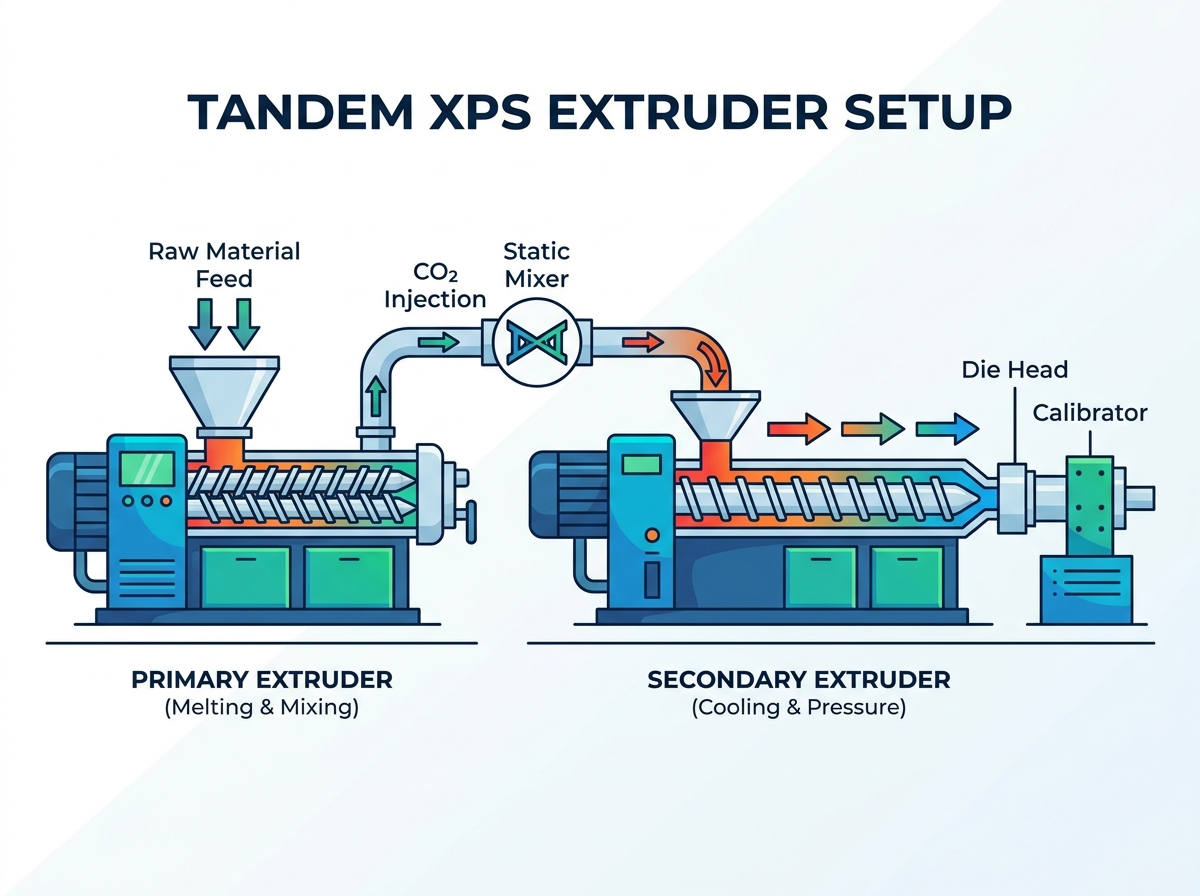
Modern manufacturing requires a strict shift toward environmentally compliant foaming agents. The transition from legacy CFCs and HCFCs to CO2 is a strict regulatory necessity. It is no longer just a green marketing feature. Environmental protection agencies worldwide now mandate zero ozone depletion potential. They also enforce stringent limits on global warming potential. CO2 serves as an excellent, low-cost alternative blowing agent. However, transitioning to CO2 completely changes the fluid dynamics within the extrusion barrel. You must upgrade your injection systems to handle this specific chemistry.
Injecting CO2 demands highly specialized high-pressure metering pumps. These pumps must inject CO2 or multi-component blowing agents with absolute precision. Supercritical CO2 requires operating pressures often exceeding 200 bar. Standard legacy pumps simply cannot maintain this consistent pressure. Inadequate pump accuracy inevitably leads to density fluctuations. These fluctuations cause severe structural failures and uneven board thicknesses. We strongly advise investing in premium diaphragm or plunger metering pumps. These ensure volumetric consistency regardless of barrel back-pressure.
Once injected, the gas must blend perfectly into the polymer melt. Static mixers and heat exchangers handle this critical task. They ensure the blowing agent dissolves homogeneously into the polymer matrix. This dissolving process must finish before the material ever reaches the die head. Static mixers use internal geometrical elements to fold and blend the flow repeatedly. They eliminate concentration gradients within the melt stream. A well-designed heat exchanger then stabilizes the mixture temperature. This combination guarantees a uniform microcellular foam structure upon expansion.
Always use mass flow meters to verify exact blowing agent dosing rates.
Monitor pump inlet pressures continuously to prevent costly cavitation.
Install redundant filtration systems upstream to protect sensitive pump valves.
Calibrate injection nozzles monthly to prevent localized clogging.
The extrusion die head dictates the initial shape of the expanding foam. Manufacturers typically rely on heavy-duty slot die configurations. These dies feature specialized thickness adjustment mechanisms. The die lip must withstand extreme internal pressures without deflecting. A perfectly rigid die delivers a highly uniform melt sheet. Any warping in the die lips creates uneven board surfaces. Advanced dies incorporate internal oil heating channels. These channels maintain exact temperatures right up to the exit point. This prevents premature skin freezing and ensures smooth surface expansion.
Immediately after the die, the melt enters the calibrator or forming table. The calibrator physically dictates the final board thickness and surface flatness. The expanding foam presses against top and bottom calibration plates. Precise water cooling circuits chill these plates continuously. This rapid cooling locks in the foam structure instantly. Many advanced forming tables also utilize vacuum assistance. The vacuum pulls the board surface tight against the cooling plates. This mechanism improves dimensional accuracy and prevents surface corrugation during the curing phase.
Moving the continuous board requires synchronized haul-off units. A complete line utilizes a first and second haul-off setup. These tractor units pull the board through the XPS foam extrusion equipment steadily. They must grip the material firmly without inducing mechanical stress. Too much tension causes the board to stretch and deform. Too little tension causes pile-ups inside the calibrator. High-precision servo motors usually drive these units. The dual haul-off system isolates tension zones, allowing the board to stabilize naturally between pulling stages.
After the board fully cools, automated cutting saws handle exact length sizing. Cross-cutting must occur rapidly while the board remains in continuous motion. Flying cutoff saws track the line speed to make perfectly square cuts. Edge trimming proves equally critical for market readiness. The edges must meet strict construction industry joint standards. Saws precisely shape profiles like shiplap or tongue-and-groove joints. These precise joints prevent thermal bridging when builders install the boards. Poorly trimmed edges render the product unusable for high-end construction projects.
Surface milling and grooving complete the physical shaping process. For a fully optimized XPS insulation board machine setup, surface planers act as essential components. These planers aggressively remove the smooth outer skin of the board. Skin removal drastically enhances adhesive bonding properties. Construction applications require this rough surface to apply plaster, cement, or specialized glues. Milling machines can also cut intricate drainage grooves into the board surface. These variations allow manufacturers to serve niche roofing and foundational markets.
Cutting and milling generate substantial amounts of scrap material. Integrating inline recycling systems safeguards your profit margins directly. Edge-trim crushers sit alongside the production line to catch offcuts immediately. Granulators then chop this scrap into reusable flakes. Automated pneumatic systems feed these flakes directly back into the primary extruder hopper. Treating scrap as a valuable raw material reduces overall resin costs. An efficient recycling loop means almost zero material waste leaves your factory floor.
Extrusion Line Equipment Checklist
Equipment Category | Critical Component | Primary Function |
|---|---|---|
Primary Mixing | Twin-Screw Extruder | Melts resin and disperses additives using high shear. |
Cooling & Pressure | Single-Screw Extruder | Cools the melt and prevents premature gas expansion. |
Fluid Dynamics | High-Pressure Pumps | Injects CO2 accurately at pressures exceeding 200 bar. |
Shaping | Vacuum Calibrator | Dictates final thickness using chilled plates and vacuum. |
Auxiliary Integration | Inline Granulator | Crushes edge trim and feeds it back to the primary hopper. |
Buyers must look far beyond the initial equipment purchase price. Evaluating capital and operational expenditures ensures long-term profitability. You should closely analyze expected energy consumption rates. Request data on the required kilowatts per kilogram (kW/kg) of output. Highly efficient lines use advanced barrel insulation and optimized motor drives. Furthermore, assess local spare parts availability and expected maintenance downtime. Waiting weeks for a replacement pump seal destroys production schedules. Choose a vendor offering robust regional support and standard, readily available electrical components.
Automation and integration reality separate modern equipment from outdated machinery. Assess the vendor's Programmable Logic Controller (PLC) systems thoroughly. A premium line automatically adjusts haul-off speeds based on real-time die pressure. Closed-loop control systems minimize human error and material waste. You must also ask whether the machinery integrates seamlessly into existing factory ERPs. Modern plants rely on data tracking for quality control. The XPS extrusion line should export production metrics, downtime logs, and energy usage automatically.
Never finalize a purchase without stringent vendor testing protocols. Recommend and enforce a comprehensive Factory Acceptance Test (FAT). Buyers should always demand a full test run at the manufacturing facility. This test must use your exact specific resin grades. It must also use your intended blowing agent formulations. Running a generic test formulation hides potential equipment flaws. A rigorous FAT guarantees the line achieves promised throughput rates before shipping. It acts as your final safeguard against receiving inadequate machinery.
Ignoring the energy efficiency ratings of the main extruder motors.
Failing to test the exact blowing agent mixture during the FAT.
Overlooking the local availability of proprietary spare parts.
Accepting a manual gauge system instead of a fully integrated PLC.
A complete XPS board manufacturing line represents a highly complex interplay of advanced technologies. It merges tandem extrusion, precise fluid dynamics, and rigorous downstream shaping into one continuous process. Successfully producing high-quality insulation requires every single component to perform perfectly. From the primary twin-screw mixer to the final edge-trim granulator, synchronization remains essential.
We encourage buyers to audit their current infrastructure thoroughly today. Calculate your available electrical power, floor space, and cooling water capacity carefully. Securing these utilities early prevents costly installation delays later. Understanding your facility limits helps vendors propose the most accurate equipment configurations.
Take proactive steps to ensure your next procurement phase succeeds. Download a technical spec sheet checklist to benchmark different manufacturer proposals. Alternatively, contact a specialized engineering consultant for a custom line layout consultation. Expert guidance ensures your investment yields a reliable, high-capacity production environment.
A: Tandem systems split the melting and cooling processes into two dedicated machines. The primary twin-screw extruder focuses purely on melting and mixing. The secondary single-screw extruder gently cools the melt. This two-step process is mandatory for the precise temperature control required in XPS foaming.
A: It is technically possible, but it often requires significant structural upgrades. You usually must replace the injection pumps, alter the screw design, and reinforce the die head. These components must upgrade to handle the much higher operating pressures that supercritical CO2 demands.
A: Certain auxiliary units remain absolute non-negotiables for stable production. You must install robust industrial water chillers and heavy-duty air compressors. Precise raw material gravimetric dosing systems and automated edge-trim recycling units also prove essential for maintaining operational efficiency.
A: You should plan for a realistic baseline of 80 to 120 meters in total length. This extensive footprint accommodates the tandem extruders, the lengthy cooling calibrators, the cutting stations, and the downstream stacking automation necessary for high-volume production runs.


