


Views: 0 Author: Site Editor Publish Time: 2026-08-04 Origin: Site


Phasing out HCFCs and CFCs in favor of CO2 represents a strict regulatory necessity for modern industrial facilities. However, utilizing supercritical CO2 as a blowing agent introduces severe thermodynamic complexities into your manufacturing process. The engineering tolerances of your extrusion equipment directly dictate the market viability of your final product. Minor equipment flaws easily translate to unacceptable scrap rates, wasted raw materials, and downgraded board specifications.
We designed this guide to equip plant managers, process engineers, and investors with an evidence-based framework. You will learn exactly how specific machinery components influence critical board qualities. By understanding these mechanical dependencies, you can mitigate capital expenditure risks and optimize your facility for sustainable, high-yield production. We will explore the technical realities behind successful extrusion, ensuring you evaluate vendor equipment based on measurable performance criteria rather than theoretical output capacities.
Structural Integrity: Consistent compressive strength and density depend heavily on the line’s melt temperature and dynamic cooling controls.
Thermal Performance: Achieving standard-compliant R-values requires flawless supercritical CO2 dispersion to maintain a uniform closed cell XPS foam structure.
Machinery Evaluation: When shortlisting vendors, prioritize gravimetric dosing precision, twin-screw compounding capabilities, and inline measurement integration over theoretical output capacities.
Implementation Reality: Transitioning to CO2 requires accepting a steeper operational learning curve; vendor-supplied training and maintenance support are non-negotiable for rapid ROI.
The industrial shift from traditional Freon-based foaming to CO2 never operates as a simple 1:1 substitution. CO2 possesses significantly higher volatility compared to legacy blowing agents. It demands much higher operational pressures inside the extrusion barrel to remain stable. Operators must navigate a significantly narrower processing window. Traditional equipment simply lacks the thermodynamic controls required to manage these intense pressure and temperature fluctuations.
A successful equipment installation must achieve complete environmental compliance. This means delivering zero Ozone Depletion Potential (ODP) and ultra-low Global Warming Potential (GWP). However, you must achieve this without sacrificing the stringent mechanical and thermal benchmarks expected by the construction sector. Builders and contractors refuse to compromise on insulation R-values or compressive load capacities simply because a board uses green chemistry. Your final product must perform identically to, or better than, legacy materials.
Your production success hinges on one definitive factor. Your machinery must keep CO2 in a supercritical state and dissolve it uniformly into the polystyrene melt. Supercritical CO2 acts as a powerful plasticizer. It drastically reduces melt viscosity upon injection. If your CO2 XPS extrusion technology fails to manage this viscosity drop through precise cooling, the gas escapes prematurely. Mastering this core dependency separates premium, market-ready boards from reject-pile scrap.
The Dependency: Your final board's structural integrity is dictated by the secondary extruder's cooling efficiency and the precision of the calibration die. Improper cooling protocols lead directly to varied cell sizes throughout the polymer matrix. Large, over-expanded cells create structural weak spots under physical load. Conversely, under-expanded cells increase board density unnecessarily, consuming excess raw material.
Best Practice: Implement multi-zone dynamic cooling on the secondary extruder. This allows operators to fine-tune the melt temperature profile precisely before the material reaches the die.
Common Mistake: Relying on static cooling parameters. Ambient factory temperatures often fluctuate, requiring active adjustments to maintain consistent density distribution.
The Dependency: The insulation market demands absolute stability in R-values. This relies fundamentally on achieving an intact closed cell XPS foam matrix. If your supercritical CO2 injection pump fluctuates even slightly, internal pressure variations occur. These fluctuations cause fragile cell walls to rupture instantly during expansion. Ruptured cells allow insulating gases to escape rapidly. Furthermore, broken cell walls invite moisture ingress over time, which catastrophically degrades long-term thermal resistance.
The Dependency: Surface aesthetics and dimensional stability remain tied tightly to the mechanical synchronization of the haul-off unit and the calibration boards. The haul-off tractor must pull the forming boards at an exact, continuous speed. Any tension inconsistencies cause severe defects. Pulling too fast induces shrinkage and stress fractures. Pulling too slowly causes warping or thicker edges, commonly known in the industry as "dog-bone" profiles.
The Dependency: Safety compliance relies exclusively on your gravimetric dosing system and the primary twin-screw extruder's shear rate. Flame retardants must disperse perfectly throughout the polymer melt. Uneven mixing results in localized chemical deficiencies. During standardized flammability testing, these deficient zones ignite, causing the entire batch to fail. Reliable equipment ensures every square inch of the board contains the exact required ratio of safety additives.
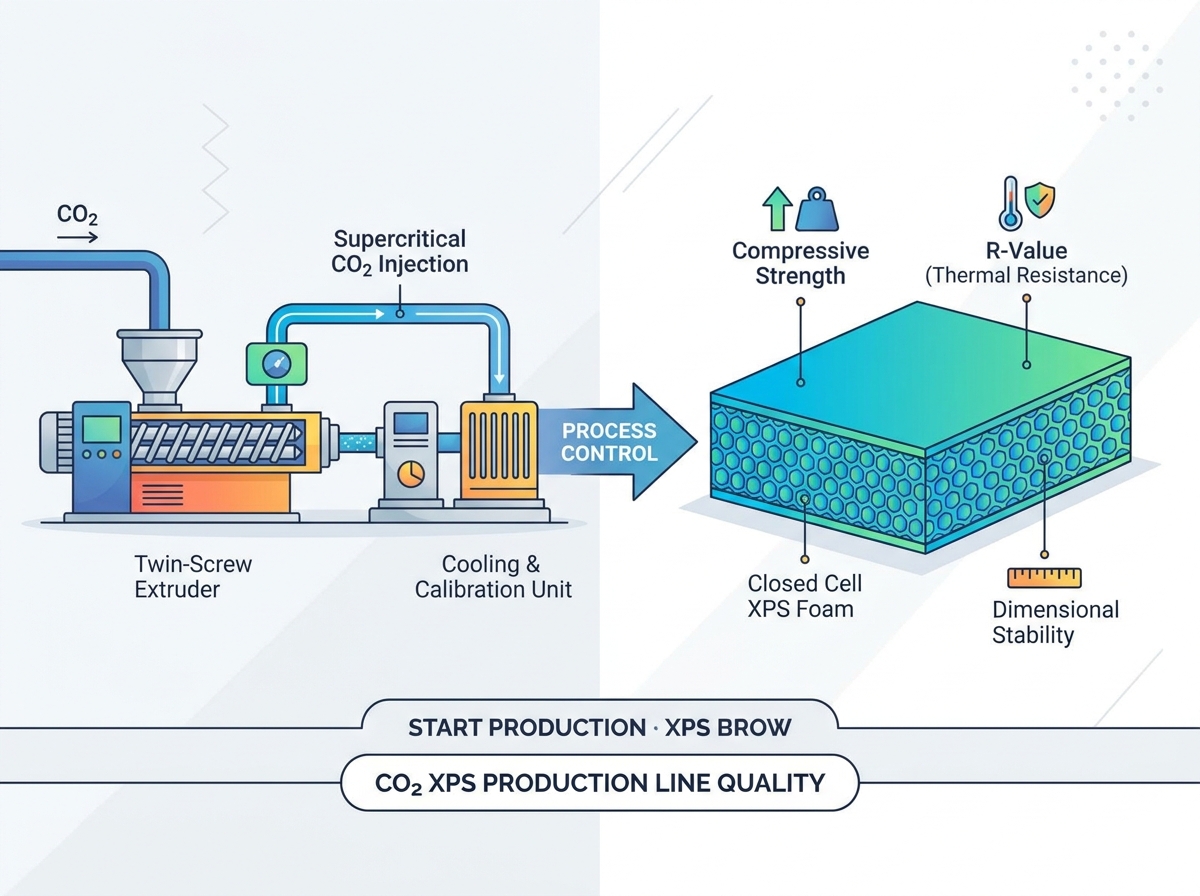
Securing profitable XPS insulation board production requires you to look past marketing claims. You must evaluate the raw mechanical capabilities of the extrusion line. Procurement teams should prioritize specific hardware configurations that manage thermodynamic volatility effectively.
Always evaluate the Length to Diameter (L/D) ratio of the primary extruder. Twin-screw systems offer vastly superior distributive mixing compared to single-screw alternatives. This intense compounding is absolutely essential for incorporating solid nucleating agents and specialized flame retardants alongside liquid CO2. A strong twin-screw setup prevents chemical agglomeration, ensuring a homogenous melt mixture before it enters the secondary cooling phase.
You must scrutinize the gas injection hardware. Look exclusively for high-precision metering pumps equipped with active closed-loop feedback. Flow rate consistency must be guaranteed mathematically, regardless of fluctuating melt back-pressure inside the barrel. If the polymer pressure spikes, the injection pump must instantly adapt its force to maintain a steady volumetric flow of CO2. Inferior pumps suffer from pulsation, which injects unpredictable voids directly into the foam structure.
Assess the sheer heat exchange capacity of the secondary extruder. Because CO2 drops melt viscosity so aggressively, the secondary extruder must act as a massive, highly efficient heat sink. The system must drop the melt temperature precisely to the blowing agent's optimum foaming window. If it cools too aggressively, the polymer solidifies prematurely and clogs the die lips. If it cools insufficiently, the melt lacks the strength to hold the expanding gas, causing immediate structural collapse.
Credible, modern extrusion lines support automated quality control integration. They feature laser or ultrasonic sensors for continuous thickness, width, and density monitoring. This automation allows operators to adjust die lips and tractor speeds in real-time. Discovering dimensional faults post-production wastes massive amounts of material. Inline measurement ensures every board hits the stacking unit perfectly within specification.
Machinery Dependency Summary Chart
Machinery Component | Controlled Variable | Direct Impact on Board Quality |
|---|---|---|
Twin-Screw Primary Extruder | Additive Dispersion & Shear Rate | Fire retardancy uniformity and cell nucleation consistency. |
CO2 Metering Pump | Injection Pressure & Volume | Long-term R-Value stability and closed-cell integrity. |
Secondary Extruder Cooling | Melt Viscosity & Temperature | Compressive strength and optimal density distribution. |
Haul-Off Unit Calibration | Pulling Tension & Speed | Surface flatness and overall dimensional stability. |
Navigating XPS foam board manufacturing with environmental blowing agents requires acknowledging harsh operational truths. The transition demands technical maturity from your engineering team. Anticipating these manufacturing risks prevents unexpected downtime and budget overruns.
Formulating with CO2 narrows the processing window severely. Plant managers must discuss the reality of cell collapse, often called corrugation. If the melt temperature is even slightly miscalibrated at the die exit, the polymer lacks the tensile strength to trap the expanding CO2. The cells implode instantly upon atmospheric exposure. You end up with a dense, wavy, and commercially useless sheet of plastic. Mastering thermal energy removal is your primary defense against corrugation.
Transparently acknowledge that dialing in a new CO2 line involves inevitable initial material waste. Vendor claims promising "instant perfect boards" on day one should be met with extreme skepticism. Finding the perfect equilibrium between screw speed, injection pressure, and cooling temperatures takes deliberate trial and error. Expect to generate scrap during the commissioning phase. Budgeting for this startup waste ensures your project financials remain accurate and realistic.
Operating with CO2 requires significantly higher internal barrel pressures than traditional Freon systems. This intense pressure puts increased, constant wear on seals, screws, and barrels. Mechanical fatigue accelerates. You must establish rigorous, predictable maintenance schedules. Replacing high-wear components proactively prevents catastrophic mid-run failures. Securing readily available spare parts from your vendor is critical to avoiding extended factory downtime. A strong preventive maintenance culture protects your production output.
Selecting a machinery vendor is the most consequential decision you will make. You must move beyond glossy brochures and rigorously test their engineering claims. Use the following steps to evaluate the capability of a CO2 XPS production line before signing any procurement contracts.
Require Proof of Concept: Demand comprehensive case studies or, preferably, live factory demonstrations. Watch the equipment maintain steady-state production over several hours. Verify visually that the machine can produce the specific board thickness and density your regional market requires without triggering foam collapse.
Assess Software and Automation: Modern extrusion requires digital precision. Ensure the lines utilize advanced PLCs (Programmable Logic Controllers). The software should automatically adjust primary screw speeds and gas injection rates based on real-time melt pressure data. Manual adjustments are simply too slow to prevent cell rupture.
Evaluate After-Sales Technical Support: World-class equipment performs poorly under untrained operators. Prioritize vendors who offer deep, comprehensive on-site commissioning. Ensure they provide exhaustive troubleshooting training for your engineering team. Rapid response support limits costly production halts during your crucial first year of operation.
Investing in a modern CO2 XPS production line is fundamentally an investment in total board quality control. The structural and thermal performance of your insulation boards depends entirely on how well your machinery handles thermodynamic stress.
As you move toward procurement, prioritize engineering tolerances over marketing promises. Focus intensely on primary compounding efficiency, precise gas metering, and dynamic cooling capabilities. Base your final procurement decision on the machinery’s demonstrated ability to tightly control these critical variables. Competing solely on the lowest initial capital cost frequently results in elevated scrap rates and compromised product standards. Equip your facility with technology built for precision, and you will secure a dominant, sustainable position in the insulation market.
A: Yes, but it requires highly precise cooling and calibration systems to manage CO2's rapid expansion rate and maintain cell integrity. Without advanced dynamic cooling, the cells easily distort, leading to varied density and reduced physical load-bearing capacity.
A: Unstable melt temperatures or uneven tension in the haul-off and calibration units typically cause surface tearing or rippling. If the tractor pulls the forming board inconsistently, operators will observe immediate warping and severe "dog-bone" edge profiles.
A: Historically, yes, but modern tandem extrusion lines with advanced cooling technology and optimized die designs can now produce thick boards (up to 100mm+) without cell collapse. The key is managing melt viscosity perfectly right up to the die lip.
A: Exceptionally critical. Gravimetric dosing ensures exact ratios of nucleating agents and flame retardants, which dictate both the cell structure and safety compliance of the final board. Uneven additive mixing frequently leads to localized flammability test failures.


