


Views: 0 Author: Site Editor Publish Time: 2026-08-10 Origin: Site


Inconsistent cell structures in XPS foam board manufacturing lead to massive scrap rates. These hidden structural flaws severely compromise compressive strength. They also cause failed thermal resistance (R-value) tests during quality control. Today, manufacturers are actively shifting away from high-GWP blowing agents. Supercritical CO2 has rapidly become the accepted industry standard. However, this transition presents distinct physical challenges. CO2 features high volatility under heat. Standard injection methods often trigger extreme pressure fluctuations inside the barrel.
Upgrading to a precision-engineered CO2 XPS production line solves these critical processing issues. Facility managers must carefully evaluate new metering systems. You need equipment capable of stabilizing the entire extrusion environment. Doing so ensures regulatory compliance while aggressively protecting your operational margins. In this article, you will learn the true financial costs of blowing agent inconsistency. We will explore how precise thermodynamic control stabilizes complex extrusion dynamics. Finally, you will discover the exact criteria needed to shortlist a highly capable metering system.
Precision CO2 metering eliminates pressure drops, ensuring a uniform closed cell XPS foam structure.
Accurate mass flow control directly correlates to predictable board density and thickness.
Evaluating metering systems requires assessing pressure tolerance, twin-screw extruder integration, and automated feedback loops.
Proper implementation reduces blowing agent waste and ensures regulatory compliance with global low-GWP mandates.
Fluctuating blowing agent injection causes severe physical defects. You often see "pinholing" forming on the board surface. An uneven surface finish immediately signals underlying structural issues. Density gradients form rapidly across the board profile. The center might become dense while the edges remain brittle. These variations destroy product predictability. They also drive up your daily manufacturing costs.
Micro-fluctuations in CO2 delivery increase board rejection rates. Every single rejected board wastes raw polymer materials. You lose money on resin, electricity, and operator labor. Poor gas dispersion directly degrades end-product performance. If gas bubbles collapse, the board loses its essential insulating properties. Consistent metering protects your material yield directly. It ensures you produce saleable products every single shift.
Building codes demand strict physical properties from insulation materials. They mandate exact compressive strength minimums. They also require highly specific thermal insulation values. Failing these local codes means you cannot sell the batch.
Pinholing: Tiny surface ruptures caused by localized gas pockets expanding too rapidly.
Density Gradients: Uneven weight distribution where certain sections lack sufficient gas expansion.
Corrugation: Wavy surface textures resulting from pulsing pressure at the die lip.
Cell Collapse: Internal structure failure leading to poor thermal resistance.
Experienced facility managers track material yield closely. They know inconsistent blowing agent delivery is the primary culprit behind low yield. Upgrading the injection control mechanism stops this financial drain immediately.
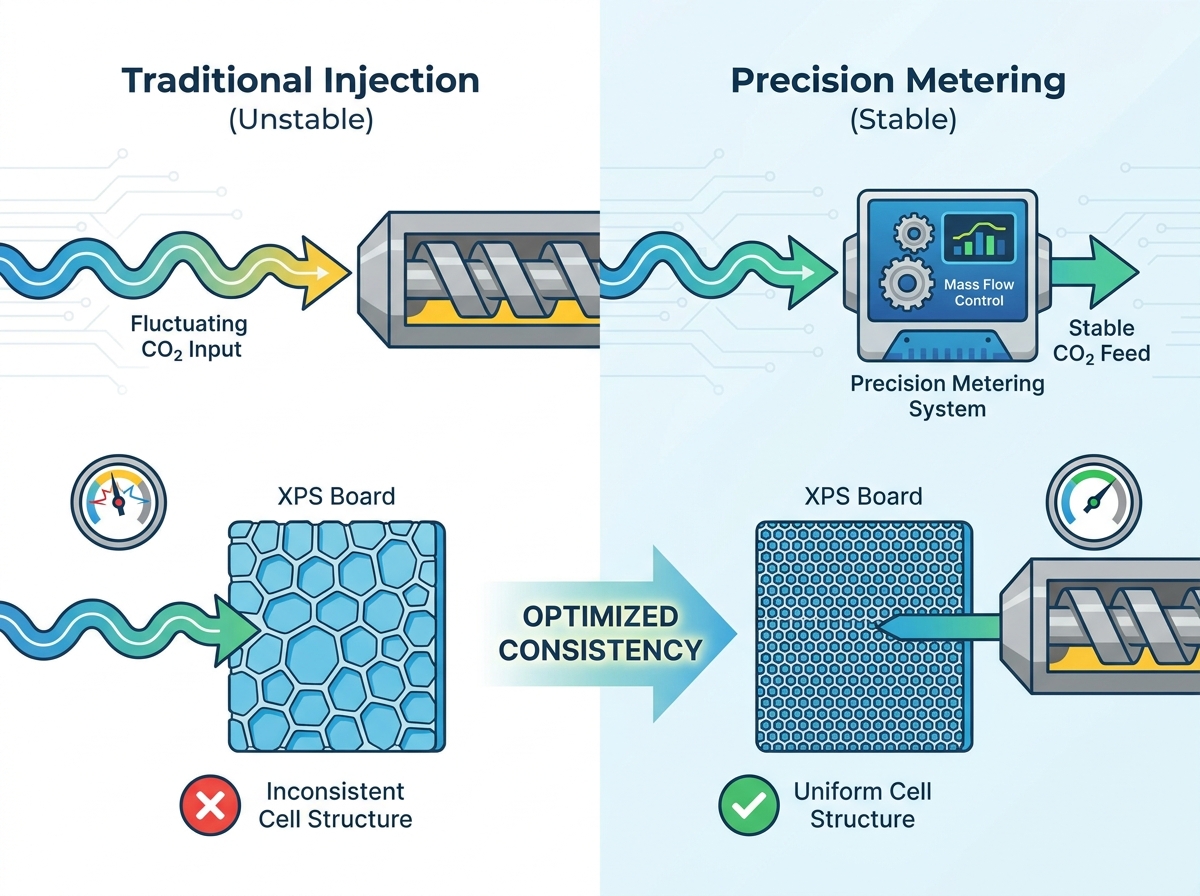
Managing the phase change of CO2 requires intense precision. The gas must reach a supercritical state before entering the melt stream. Supercritical fluids behave like both a liquid and a gas. This unique state allows optimal dispersion into the molten polymer. Moving from rudimentary pressure-based injection changes everything. You need continuous, precision mass flow metering.
Many modern facilities pair Coriolis meters with reliable diaphragm pumps. This specific setup maintains a constant feed rate. Extruder backpressure fluctuates constantly during normal operations. However, advanced mass flow meters adjust pump speeds instantly. They ignore volumetric changes and measure actual gas mass. This ensures the extruder receives exactly what it needs.
Steady gas dissolving dictates uniform cell nucleation. When nucleation occurs evenly, structural integrity skyrockets. A highly uniform closed cell XPS foam emerges smoothly from the die. Every single cell remains tightly packed and structurally sound. This uniformity defines high-quality building insulation.
Extrusion Injection Methods Comparison Chart
Parameter | Pressure-Based Injection | Mass Flow Metering |
|---|---|---|
Measurement Metric | Volume and Line Pressure | True Mass Flow (kg/hr) |
Response to Backpressure | Highly susceptible to fluctuations | Immune; adjusts automatically |
Gas Dispersion | Uneven; prone to surging | Highly consistent |
Cell Structure Result | Variable sizes; higher defect risk | Uniform and tightly packed |
Best practice requires chilling the CO2 well before it hits the pump head. Pumping liquid CO2 is much easier than pumping a volatile gas. Keeping the fluid dense prevents cavitation inside the pump mechanism.
You must ensure total compatibility with your existing CO2 XPS extrusion technology. Metering pumps must connect seamlessly to tandem and twin-screw extruder setups. Physical connection points require specialized high-pressure fittings. Furthermore, communication protocols matter immensely. Your new metering skid must talk to existing PLC and SCADA systems. Seamless integration enables true closed-loop control. The pump needs real-time screw speed data to adjust gas delivery dynamically.
You need to evaluate the required flow range thoroughly. Compare your daily flow needs against the pump's operational sweet spot. A common mistake involves buying an oversized pump. If your normal flow sits at the bottom 10% of the pump's capacity, accuracy plummets. You need a pump where normal operations sit squarely in the middle of its turndown ratio.
Real-time mass flow feedback outperforms simple volumetric estimates. Volumetric pumps guess the amount of gas based on stroke length. Mass flow meters weigh the fluid constantly. They provide undeniable accuracy regardless of temperature shifts.
Supercritical CO2 demands robust system ratings. The equipment must handle extreme cooling requirements. You must keep liquid CO2 cold to prevent premature flashing in the pump heads. If the liquid turns into gas inside the pump, vapor lock occurs. The pump will spin without moving any material. This starves the extruder instantly.
Look for metering units featuring integrated cooling jackets. These jackets circulate chilled water around the pump heads. They absorb excess friction heat generated by the moving seals. Proper thermal management guarantees uninterrupted production runs.
Transitioning to CO2 aligns heavily with strict environmental mandates. Global regulators now target zero ODP (Ozone Depletion Potential). They also demand ultra-low GWP solutions for all foam products. CO2 fits these exact requirements perfectly. It acts as an environmentally benign blowing agent.
From an economics perspective, CO2 is significantly cheaper than traditional HFCs or HFOs. You save massive amounts on raw chemical costs. However, its volatile nature demands highly capable handling equipment. You must analyze your return on investment carefully. Compare your projected scrap reduction savings against the capital expenditure on metering upgrades. A reliable system often pays for itself within months by eliminating raw material waste.
Furthermore, you gain robust auditability. Modern metering systems utilize automated data logs. These digital logs prove your compliance with environmental manufacturing standards. You can confidently show inspectors your exact emission rates. You can prove exactly how much blowing agent entered the product.
A transparent data trail protects your business from regulatory fines. It also allows you to market your boards as certified green building materials. Eco-conscious contractors actively seek out these low-GWP products.
Realistic timelines matter when integrating a new CO2 metering skid. You must schedule adequate downtime for an active XPS insulation board production facility. Rushing the installation always leads to lingering integration bugs. Plan for at least a week of dedicated pipefitting and electrical work.
Operators face a distinct learning curve. Managing supercritical fluid parameters differs greatly from handling traditional liquid blowing agents. They need comprehensive training on the new digital controls. They must understand how temperature tweaks affect mass flow density.
Recognizing equipment wear-and-tear proves equally important. High-pressure pump seals degrade over time due to constant friction. You must establish strict preventative maintenance schedules. Ignoring these schedules leads to unplanned line stoppages.
Common Mistakes During Retrofits:
Failing to upgrade the existing extruder seals to handle higher CO2 injection pressures.
Using standard plumbing lines instead of rated high-pressure stainless steel tubing.
Skipping operator training on the new PLC interface.
Neglecting the installation of a dedicated chilling unit for the CO2 feed tank.
Proper retrofitting requires a holistic view of the extrusion line. Upgrading the pump alone is rarely enough. The mixing sections of your screw must also handle the rapid expansion of supercritical gas.
Demand verifiable performance data from all potential vendors. They must prove mass flow accuracy at your specific extrusion backpressures. Do not accept generic testing data. You need numbers relevant to foam manufacturing.
Ask for material testing or pilot-scale runs first. You need to see how the metering system handles your specific polymer blend. Different resins absorb CO2 at different rates. Do this testing before finalizing full-scale procurement. It eliminates expensive guesswork.
Beyond the initial sticker price, evaluate all ongoing operational expenses. Look closely at routine maintenance costs. Check the availability and standard lead time of critical spare parts. Monitor the projected energy consumption of the required chilling units and pumps. These factors dictate the long-term financial viability of your investment.
Focus on systems offering predictive maintenance alerts. Smart pumps monitor their own seal wear. They warn you weeks before a physical failure occurs. This intelligence allows you to schedule maintenance during planned shutdown windows.
Require your vendor to provide comprehensive on-site commissioning. The vendor should stay on the floor until the line produces saleable boards. Their expertise drastically shortens the initial learning curve.
Upgrading to precision CO2 metering is not merely a sustainability play. It remains a fundamental requirement for maintaining strict dimensional and thermal tolerances in modern XPS manufacturing. The days of relying on fluctuating pressure-based injection are over. Predictable mass flow directly creates superior cellular structures.
Manufacturers must treat the metering system as the heart of their extrusion line. You must prioritize data-driven accuracy and seamless PLC integration over baseline pumping capability. Ensure your operators understand the thermodynamic principles behind the equipment.
Start your transition by auditing your current scrap rates. Identify exactly how much blowing agent inconsistency costs you annually. Then, demand pilot testing from top-tier equipment vendors to prove their mass flow stability.
A: CO2 requires high pressure and strict temperature control to remain in a liquid or supercritical state. Minor thermal fluctuations cause it to flash into gas prematurely. This flashing starves the extruder, ruining the foam structure and causing immediate production defects.
A: Yes, but you must evaluate the existing equipment carefully. You need to check the extruder's pressure capacity and seal integrity. The existing screw mixing elements must also possess the ability to properly disperse supercritical CO2 into the melt.
A: Consistent metering ensures highly uniform cell nucleation. An even, tightly packed cell structure distributes physical loads evenly across the board. This uniform structure directly translates to reliable, standardized compressive strength.
A: ROI is typically realized very quickly, often within 12 to 18 months. This rapid return happens through drastically reduced scrap rates, lower raw blowing agent costs, and the ability to command premium pricing for flawless insulation boards.


