


Views: 0 Author: Site Editor Publish Time: 2026-04-17 Origin: Site


The imminent phase-out of HFCs and HCFCs is forcing insulation manufacturers to overhaul their extrusion processes. Global agreements like the Montreal Protocol and the Kigali Amendment make this transition unavoidable. Moving to alternative blowing agents often disrupts output stability. Older manufacturing setups consume massive amounts of energy. They also struggle to handle the volatile thermodynamics inherent to CO2.
Modernising your operations to a dedicated CO2-based extrusion system solves these issues. It is much more than a mere compliance play. It serves as a powerful operational expenditure (OPEX) reduction strategy. You can significantly lower the Specific Energy Consumption (SEC) per cubic meter of foam. In the following sections, you will discover how upgrading your equipment enhances thermal management, reduces mechanical load, and drives long-term profitability.
Upgrading to modern CO2-based extrusion can reduce specific energy consumption from legacy averages of ~25 kWh/m³ down to ~16 kWh/m³.
Successfully saving energy with CO2 requires strict, three-stage liquid state temperature/pressure control to prevent premature vaporization.
Evaluating the XPS production line price must be done through a Total Cost of Ownership (TCO) lens, factoring in OPEX reductions and elimination of compliance penalties.
Strategic blending of CO2 and N2 via precision metering pumps allows manufacturers to optimize both foam density (30-45 kg/m³) and thermal resistance (R-value).
Regulatory drivers are aggressively reshaping the insulation industry landscape. The 2030 deadlines for R22 and HFC phase-outs are approaching fast. Because of these strict mandates, legacy extrusion systems are rapidly becoming stranded assets. You cannot rely on outdated chemical blends if you want to remain competitive and compliant in the coming decade.
Legacy XPS production line configurations suffer from a problematic energy baseline. They inherently feature poor thermal efficiency and demand exceptionally high mechanical loads. Older plants typically consume around 25 kWh of electricity per cubic meter of extruded foam. This excessive power draw erodes profit margins and inflates your factory carbon footprint.
A viable replacement system must meet rigorous success criteria. To justify the capital investment, modern equipment must achieve a minimum 30% reduction in power consumption. It must simultaneously increase overall volumetric capacity. Crucially, the new machinery should accomplish this output boost without requiring you to expand your existing factory footprint. This dual requirement demands highly optimized engineering and superior thermal management.
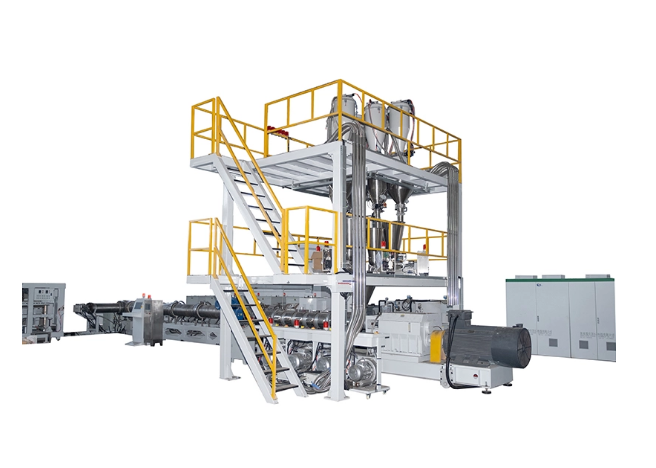
Understanding how a modern CO2 foam XPS production line slashes energy consumption requires looking inside the machinery. The energy savings stem directly from structural changes in the extrusion mechanics and heat management protocols. We can break these core mechanisms down into three primary operational shifts.
Optimized Twin-Screw Extrusion: Modern high-torque twin-screw designs drastically improve melt homogenization. They achieve better mixing at much lower revolutions per minute (RPM). Running the screws at slower speeds directly reduces the continuous motor load. Less mechanical effort means less electricity pulled from the grid.
Advanced Heating and Cooling Loops: Old equipment relies on outdated barrel heating methods. These legacy methods bleed heat into the factory air. Upgraded lines replace this with closed-loop, highly insulated thermal management systems. Minimizing heat loss ensures thermal energy stays inside the polymer melt where it belongs.
Efficient Blowing Agent Dispersion: CO2 behaves uniquely inside the extruder. It possesses exceptionally high solubility in polystyrene. As a result, CO2 plasticizes the polymer melt much faster than older blowing agents. This rapid plasticization softens the mixture rapidly. It drastically reduces the mechanical shear energy required from the extruder motors compared to processing thick, viscous HFC mixes.
By attacking energy waste at the motor, the heating element, and the chemical levels, modern systems transform production efficiency.
You face a significant volatility risk when introducing CO2 into the manufacturing process. CO2 is highly prone to rapid vaporization. If it flashes into gas before entering the extruder, it causes catastrophic dry ice blockages. These blockages force sudden production halts and generate massive material and energy waste.
Keeping CO2 in a pure liquid state is mandatory. Plant operators must implement a strict, three-stage temperature and pressure control protocol. Failing at any of these three stages will compromise your entire foam structure.
Storage: You must store the raw material in vacuum-insulated tanks. Keep these main tanks at a strict -20°C and maintain pressure between 1.6 and 2.0 Mpa.
Transfer and Buffer: Utilize heavy-duty booster pumps to move the liquid. These pumps should possess 10 times your actual metering capacity. They push the liquid into an intermediate tank held at 25°C and 6.5 to 7 Mpa. You must integrate strict 70% liquid-level alarms here. This buffer space prevents dangerous supercritical expansion during unexpected summer power outages.
Injection Cooling: Finally, you must chill the CO2 down to 10°C immediately before the twin-screw injection point. This final, dramatic temperature drop guarantees you meter pure liquid into the melt, avoiding gas bubbles entirely.
Mastering these thermodynamic stages separates highly profitable facilities from those plagued by constant downtime and scrapped boards.
Metering precision acts as the heartbeat of a modern extrusion facility. Fluctuations in gas injection waste raw materials and inflate power usage. Poor injection control forces operators to scrap thousands of off-spec, low-density boards. Precision keeps your material yield high and your energy per unit low.
You need specific hardware capabilities to guarantee this precision. Look exclusively for corrosion-resistant pump components. Insist on digital mass flow controllers rather than analog gauges. Your system must feature closed-loop feedback systems fully integrated with the plant SCADA or PLC network. This ensures automatic, real-time adjustments without manual intervention.
Operators rarely use CO2 in isolation today. Strategic blending of Carbon Dioxide (CO2) and Nitrogen (N2) provides the ultimate control over board characteristics. Below is a detailed comparison of their distinct roles.
Blowing Agent | Solubility in Polystyrene | Primary Function & Benefit | Drawbacks if Used Alone |
|---|---|---|---|
Carbon Dioxide (CO2) | Very High | Creates exceptionally fine, dense cell structures. Excellent plasticization. | High volatility risk. Can cause dimensional shrinkage if overused. |
Nitrogen (N2) | Very Low (Inert) | Provides superior dimensional and thermal stability to the foam board. | Generates larger, less insulating cell structures. Harder to dissolve. |
Using mixed dosing units allows you to leverage the strengths of both gases. Manufacturers can dial in the exact density needed for specific markets. For example, you can target 30-45 kg/m³ to perfectly balance cold storage demands against standard residential wall requirements. Blending prevents you from over-consuming expensive gases or overtaxing extruder power limits.
Evaluating machinery purchases strictly through initial capital expenditure (CAPEX) is a dangerous trap. When you fixate only on the sticker price, you ignore the massive operational expenditure (OPEX) savings a modern system delivers. Analyzing the XPS production line price requires a comprehensive Total Cost of Ownership (TCO) lens.
The return on investment accelerates through three distinct operational drivers. First, we examine energy savings. Modernizing drops the energy requirement from 25 kWh/m³ to 16 kWh/m³. Over a standard annual production volume of 180,000 cubic meters, this 9 kWh difference translates to enormous utility cost reductions.
Second, material yield improves dramatically. Better density control means you waste far less expensive polystyrene resin per board. Third, compliance value adds bottom-line protection. Upgrading helps you avoid steep carbon taxes. It also positions your facility to secure lucrative ESG-linked manufacturing incentives from local governments.
Metric | Legacy HFC Line | Modern CO2 Line | Net Annual Difference |
|---|---|---|---|
Specific Energy (kWh/m³) | 25 kWh/m³ | 16 kWh/m³ | -9 kWh/m³ |
Annual Output (m³) | 180,000 m³ | 180,000 m³ | Equal Volume |
Total Energy Used (kWh) | 4,500,000 kWh | 2,880,000 kWh | 1,620,000 kWh Saved |
When shortlisting equipment providers, apply strict procurement logic. Prioritize manufacturers who gladly offer transparent Proportional-Integral-Derivative (PID) control schematics. Demand they guarantee these specific energy consumption metrics directly within their performance contracts. If a supplier refuses to guarantee SEC performance, their equipment will likely underperform on the factory floor.
Transitioning to a CO2-based extrusion setup is not merely about swapping one chemical for another. It requires a systemic, comprehensive upgrade in thermal tracking and high-pressure management. When executed correctly, this modernization effort fundamentally lowers your operational costs and secures your market position against future regulatory bans.
Your next steps should focus on data gathering and baseline assessment. Initiate a rigorous technical audit of your current line's energy footprint today. Use this baseline to demand concrete demonstration data on CO2 metering stability from any potential equipment suppliers you evaluate. Informed procurement ensures you achieve the projected OPEX reductions.
A: Yes, but it requires substantial upgrades to the injection ports, metering pumps, and cooling sections. Because CO2 operates under totally different thermodynamic principles, retrofits often face stability issues. Often, a full line replacement yields a better, more predictable TCO.
A: CO2 diffuses faster than HFCs, which initially lowered R-values in early iterations. However, modern lines using nano-nucleation and precise CO2/N2 gas blends counteract this problem. High-end modern systems can consistently hit R-5 per inch and are steadily pushing toward R-9.
A: Plunger pump wear and dry ice formation in the injection valves stand out as the biggest risks. Proper, preventative chiller maintenance and installing redundant booster pumps are critical strategies to mitigate these operational threats successfully.


